
Foundations of land use law
The police power, enabling acts, Dillon’s Rule and home rule, due process, equal protection, the First Amendment, cell tower siting, and the landmark zoning cases.
Lesson 8 of 40 · about 32 minutes · Outline areas: 2.3 Foundational legal principles
Learning objectives
- Explain where local land use authority comes from: the police power, enabling acts, Dillon's Rule, and home rule.
- Summarize Euclid and Nectow and the difference between facial and as-applied challenges.
- Apply substantive and procedural due process and equal protection to land use decisions, including the standard of review courts use.
- Identify the leading cases on household definitions, group homes, discriminatory intent, and "class of one" claims.
- Explain how the First Amendment limits sign, adult-use, and religious land use regulation, and how federal law limits local rules on cell towers.
- Recognize legal doctrines planners meet in practice: ultra vires, ripeness, estoppel, and standing.
Key concepts
Where the power comes from
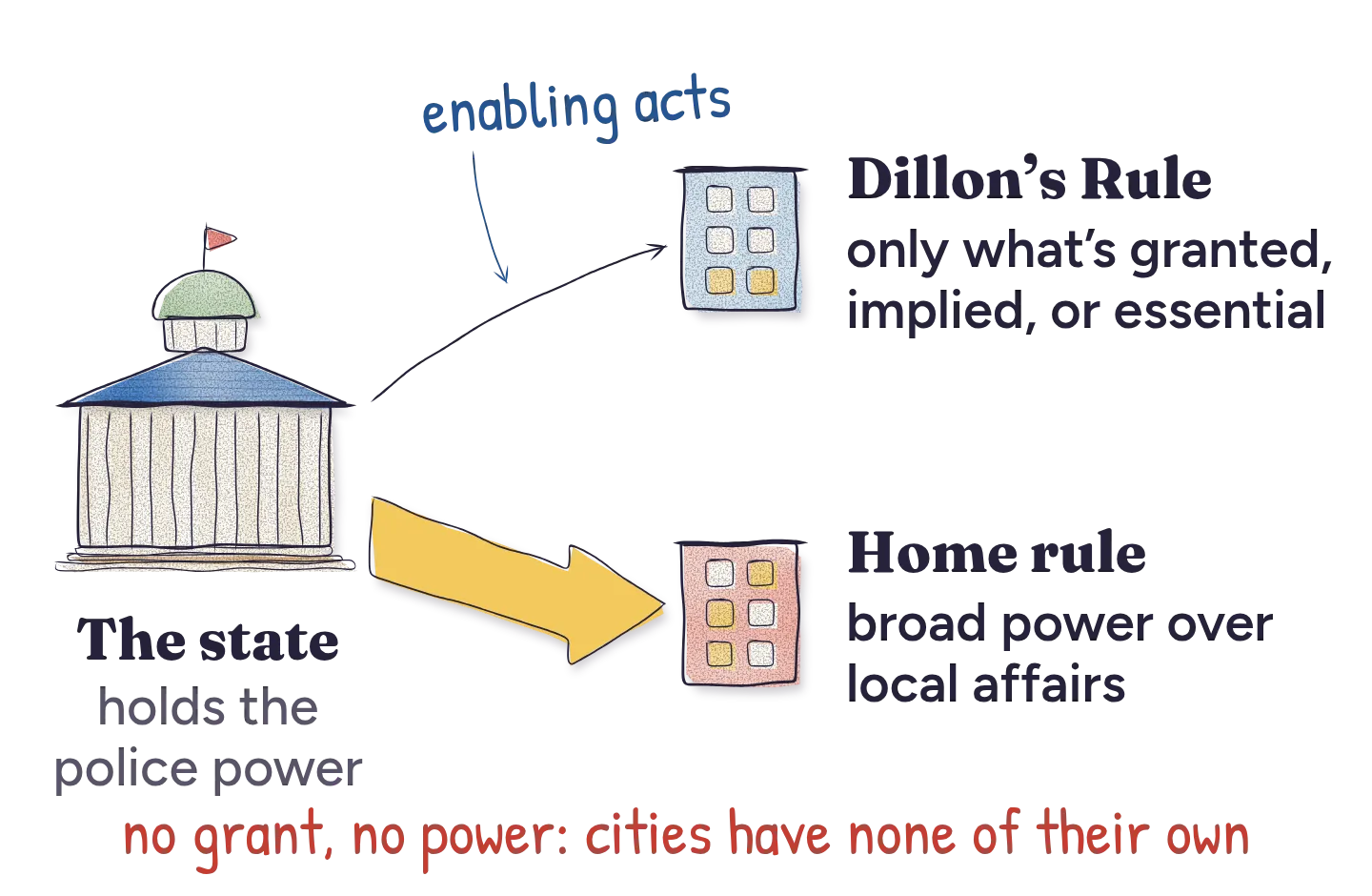
- The police power is the inherent power of state governments to regulate private conduct to protect public health, safety, morals, and general welfare. The U.S. Constitution doesn't grant it; the states have always had it, and the Tenth Amendment reserves it to them. Zoning is an exercise of the police power.
- Local governments have no inherent power. They exercise powers the state delegates to them, usually through enabling acts. Many states based theirs on two federal models: the Standard State Zoning Enabling Act (1920s) and the Standard City Planning Enabling Act (1928).
- Dillon's Rule, named for Iowa judge John F. Dillon, holds that a local government may exercise only the powers expressly granted by the state, those necessarily implied by that grant, and those essential to its purpose. When in doubt, courts construe local power narrowly.
- Home rule states give cities (sometimes counties) broad authority over local affairs without a specific grant, subject to state law.
- Preemption: state or federal law can override local rules. Examples include federal limits on regulating telecommunications towers, and federal fair housing and disability laws.
8 more sections follow in the full lesson.
Key terms
- Police power: The states' inherent power to regulate for public health, safety, morals, and general welfare.
- Enabling act: A state statute delegating planning or zoning authority to local governments.
- Dillon's Rule: The doctrine that local governments have only the powers expressly granted, necessarily implied, or essential to their purpose.
- Home rule: Broad state-granted authority for local governments to govern local affairs.
- Facial challenge: A claim that a law is invalid in all its applications.
- As-applied challenge: A claim that a law is invalid as applied to particular facts or property.
- Substantive due process: The requirement that a regulation be rationally related to a legitimate purpose.
- Procedural due process: The requirement of fair procedures: notice, a hearing, and an impartial decision-maker.
- Rational basis review: The deferential standard that upholds a law rationally related to a legitimate interest.
- Strict scrutiny: The demanding standard requiring a compelling interest and narrow tailoring.
- Class of one: An equal protection claim by a single owner treated irrationally differently from similar owners.
- Content-based regulation: A rule that applies differently depending on what a message says.
- RLUIPA: The federal law protecting religious land uses from substantial burdens and unequal treatment.
- Ultra vires: Beyond a government's legal authority, and therefore void.
- Ripeness: The requirement that a government reach a final decision before a land use or takings claim can be heard.
- Equitable estoppel: A doctrine that can bar a government from enforcing a rule when someone relied in good faith on its official act.
- Standing: The requirement that a plaintiff show a real, particular injury to challenge a decision.
Create an account to see the rest of this lesson
Every lesson and full-length practice exam is open to you. An account keeps your scores and progress in one place so you can see where to study next.
Just looking? The list of lessons and the sample questions are open to everyone.
Ready for exam-style questions?
The checkpoints in this lesson were written for it alone, so they never give away an exam question. To see how the Fundamentals domain is tested, take a full-length practice exam. It mixes all nine domains in exam proportions, and your results point you back to the lessons behind every question you miss.
Exams need an account, so your scores are saved. Create one to get started.