
Patterns of human settlement and urban form
Classic models of urban structure, bid-rent and central place theory, suburbanization, redlining and segregation, neighborhood change, and how cities are perceived.
Lesson 7 of 40 · about 27 minutes · Outline areas: 2.2 Patterns of human settlement; 2.7 Natural, social, and economic systems
Learning objectives
- Compare the concentric zone, sector, and multiple nuclei models of urban structure.
- Explain how land values sort uses by location (von Thünen, bid-rent) and how central place theory explains threshold, range, and hierarchy.
- Describe how neighborhoods change through filtering, succession, and gentrification, and how households sort among local governments.
- Describe the forces behind American suburbanization and the rise of edge cities.
- Explain how redlining, restrictive covenants, and exclusionary practices produced segregated settlement patterns, and the legal turning points that followed.
- Apply Kevin Lynch's five elements of the city image, and explain why natural, social, and economic systems must be analyzed together.
Key concepts
Classic models of urban structure
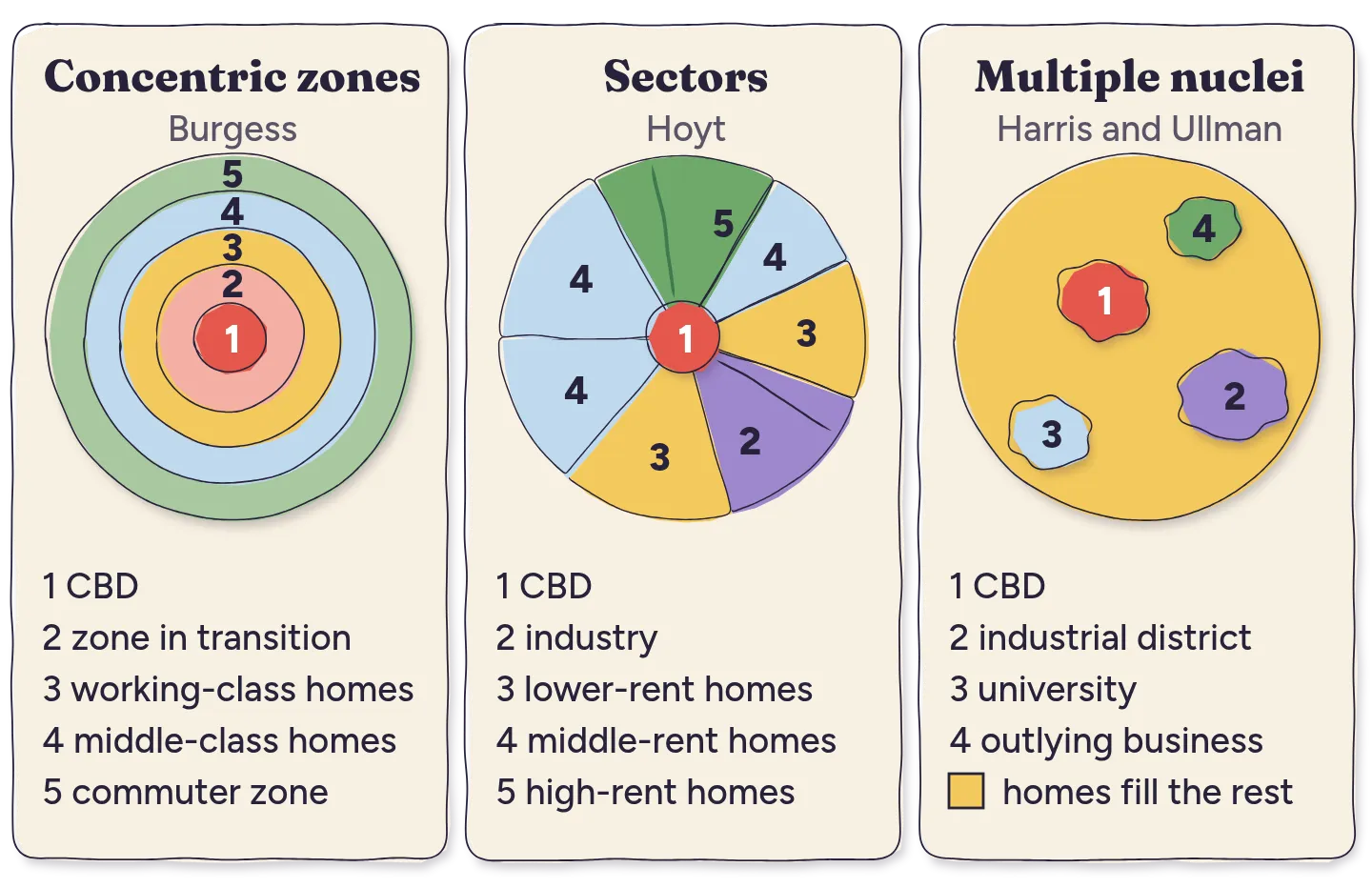
Early twentieth-century sociologists and economists tried to explain where different activities and people locate within a city. The models are simplified, but the exam expects you to recognize them.
| Model | Associated with | Picture |
|---|---|---|
| Concentric zone (1920s) | Ernest Burgess (Chicago School) | Rings around the central business district: CBD, a "zone in transition," working-class housing, middle-class housing, and an outer commuter zone. Groups move outward as they prosper. |
| Sector (1939) | Homer Hoyt | Wedges radiating from the center along transportation corridors. High-rent areas extend outward along particular sectors, such as a scenic lakefront or a main rail line, while industry and lower-rent housing follow other wedges. |
| Multiple nuclei (1945) | Chauncy Harris and Edward Ullman | Several centers (a downtown, an industrial district, a university, an outlying business center), each drawing related uses around it. |
The multiple nuclei model fits modern metropolitan regions best, with their many job and retail centers.
7 more sections follow in the full lesson.
Key terms
- Concentric zone model: Burgess's model of rings around the central business district.
- Sector model: Hoyt's model of wedges extending outward along transportation corridors.
- Multiple nuclei model: Harris and Ullman's model of several specialized centers within a city.
- Central place theory: Christaller's explanation of settlement size and spacing by the goods and services they provide.
- Threshold: The minimum market population needed to support a good or service.
- Range: The maximum distance consumers will travel for a good or service.
- Edge city: A suburban concentration of office and retail space, often at highway interchanges.
- Spatial mismatch: The distance between where low-income workers live and where suitable jobs are located.
- Redlining: The practice of denying or restricting credit in neighborhoods graded as high-risk, strongly associated with race.
- Restrictive covenant: A private deed restriction on the use or sale of property; racial covenants were held unenforceable in 1948.
- Exclusionary zoning: Zoning rules that effectively keep lower-income households out of a community.
- Imageability: Lynch's term for how easily a city forms a clear mental image.
- Bid-rent theory: The model in which land users bid for locations by the value of access, so land values fall with distance from the center.
- Rank-size rule: The pattern in which a country's nth-largest city is about 1/n the size of the largest.
- Primate city: A city far larger than any other in its country.
- Exurb: Low-density development beyond the suburbs, tied to the metro area by commuting.
- Megaregion: A network of metropolitan areas linked by economies, infrastructure, and commuting.
- Filtering: The passing of aging housing to lower-income households.
- Gentrification: Higher-income residents and investment moving into a lower-income area, often displacing existing residents.
- Tiebout sorting: Households choosing among local governments by their mix of taxes and services.
Create an account to see the rest of this lesson
Every lesson and full-length practice exam is open to you. An account keeps your scores and progress in one place so you can see where to study next.
Just looking? The list of lessons and the sample questions are open to everyone.
Ready for exam-style questions?
The checkpoints in this lesson were written for it alone, so they never give away an exam question. To see how the Fundamentals domain is tested, take a full-length practice exam. It mixes all nine domains in exam proportions, and your results point you back to the lessons behind every question you miss.
Exams need an account, so your scores are saved. Create one to get started.