
Infrastructure, energy, and water planning
How infrastructure steers growth, asset management, water supply and water rights, wastewater and stormwater, solid waste, energy siting, broadband, and fair siting.
Lesson 37 of 40 · about 23 minutes
Learning objectives
- Explain how infrastructure capacity shapes where and when growth happens, and how plans, the CIP, and extension policies connect.
- Describe asset management and why life-cycle costs matter more than construction costs.
- Summarize the planning issues in water supply, wastewater, and stormwater, including combined sewer overflows and stormwater permits.
- Distinguish riparian and prior appropriation water rights, and apply the solid waste hierarchy.
- Describe land use's role in energy planning, including renewable energy siting, electrification, and broadband.
- Recognize the equity questions in siting infrastructure and locally unwanted land uses.
Key concepts
Infrastructure shapes growth
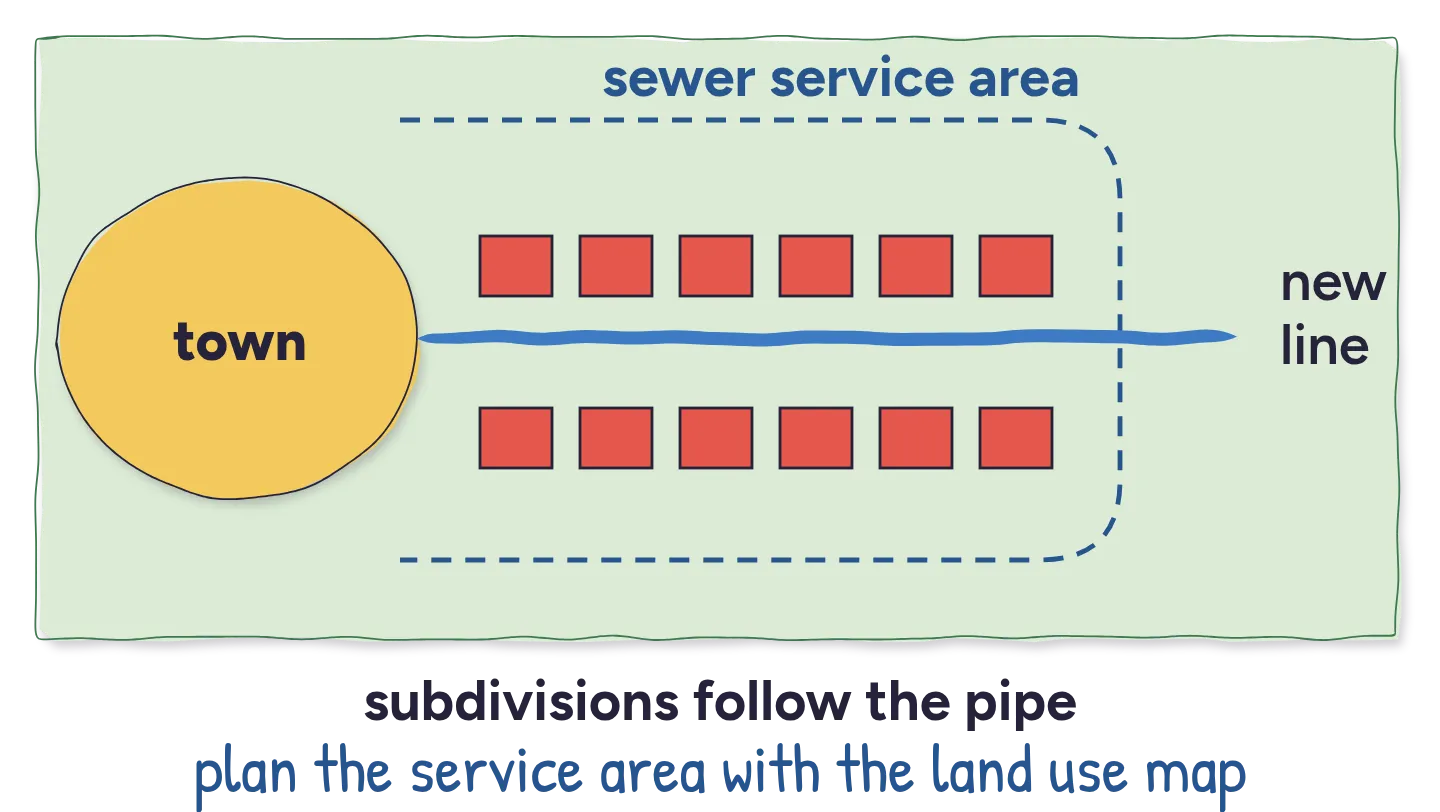
Water, sewer, roads, energy, and broadband don't just serve development; they steer it. A sewer extension can open thousands of acres to subdivision, and a lack of capacity can stop growth entirely. That's why planners coordinate:
- the comprehensive plan's land use map with utility service areas (where the jurisdiction will extend water and sewer);
- level-of-service standards and concurrency or adequate public facilities rules (see Implementation programs, partnerships, and monitoring);
- the capital improvements program, which schedules the investments (see Capital planning and public finance); and
- extension policies: who pays for new lines (often the developer) and where extensions are allowed.
When an infrastructure plan and a land use plan disagree, the infrastructure usually wins, because private development follows capacity.
8 more sections follow in the full lesson.
Key terms
- Utility service area: The area where a jurisdiction will provide or extend water and sewer service.
- Extension policy: Rules on where utility lines may be extended and who pays.
- Asset management: Managing infrastructure based on inventory, condition, remaining life, and life-cycle cost.
- Life-cycle cost: The total cost of an asset over its life, from construction through replacement.
- Deferred maintenance: Postponed repair or replacement that usually raises long-term cost.
- Combined sewer overflow (CSO): Untreated discharge when combined sewage and stormwater exceed system capacity.
- Impervious surface: Pavement, roofs, and other surfaces that prevent water from soaking into the ground.
- MS4 permit: A stormwater permit for a municipal separate storm sewer system.
- Wellhead protection: Controls on land uses near public water supply wells.
- Electrification: Shifting buildings and vehicles from fossil fuels to electricity.
- Decommissioning: Removing an energy facility and restoring the site at the end of its life.
- Dig once: A policy of installing conduit or utilities whenever streets are opened.
- LULU: A locally unwanted land use, such as a landfill or treatment plant.
- Riparian rights: Water rights held by owners of land along a water body, allowing reasonable use.
- Prior appropriation: Water rights based on first diversion to beneficial use: "first in time, first in right."
- Waste management hierarchy: Reduce and reuse, then recycle and compost, then recover energy, then dispose.
- RCRA: The Resource Conservation and Recovery Act of 1976, which governs solid and hazardous waste.
Create an account to see the rest of this lesson
Every lesson and full-length practice exam is open to you. An account keeps your scores and progress in one place so you can see where to study next.
Just looking? The list of lessons and the sample questions are open to everyone.
Ready for exam-style questions?
The checkpoints in this lesson were written for it alone, so they never give away an exam question. To see how the Areas of Practice domain is tested, take a full-length practice exam. It mixes all nine domains in exam proportions, and your results point you back to the lessons behind every question you miss.
Exams need an account, so your scores are saved. Create one to get started.