
Capital planning and public finance
The capital improvements program, bonds, tax increment financing, special assessments, impact fees, business improvement districts, and life-cycle costs and debt capacity.
Lesson 24 of 40 · about 27 minutes · Outline areas: 5.2 Aligning and activating funding and financing; 4.11 Funding and financing considerations
Learning objectives
- Explain what a capital improvements program is, how it relates to the capital budget, and why it must align with the comprehensive plan.
- Compare pay-as-you-go and debt financing, and general obligation and revenue bonds.
- Explain how tax increment financing, special assessments, and business improvement districts work.
- Apply the legal requirements for impact fees.
- Account for life-cycle and operating costs and a community's debt capacity when ranking projects.
- Respond sensibly when a funding source changes, and read a CIP table.
Key concepts
The capital improvements program
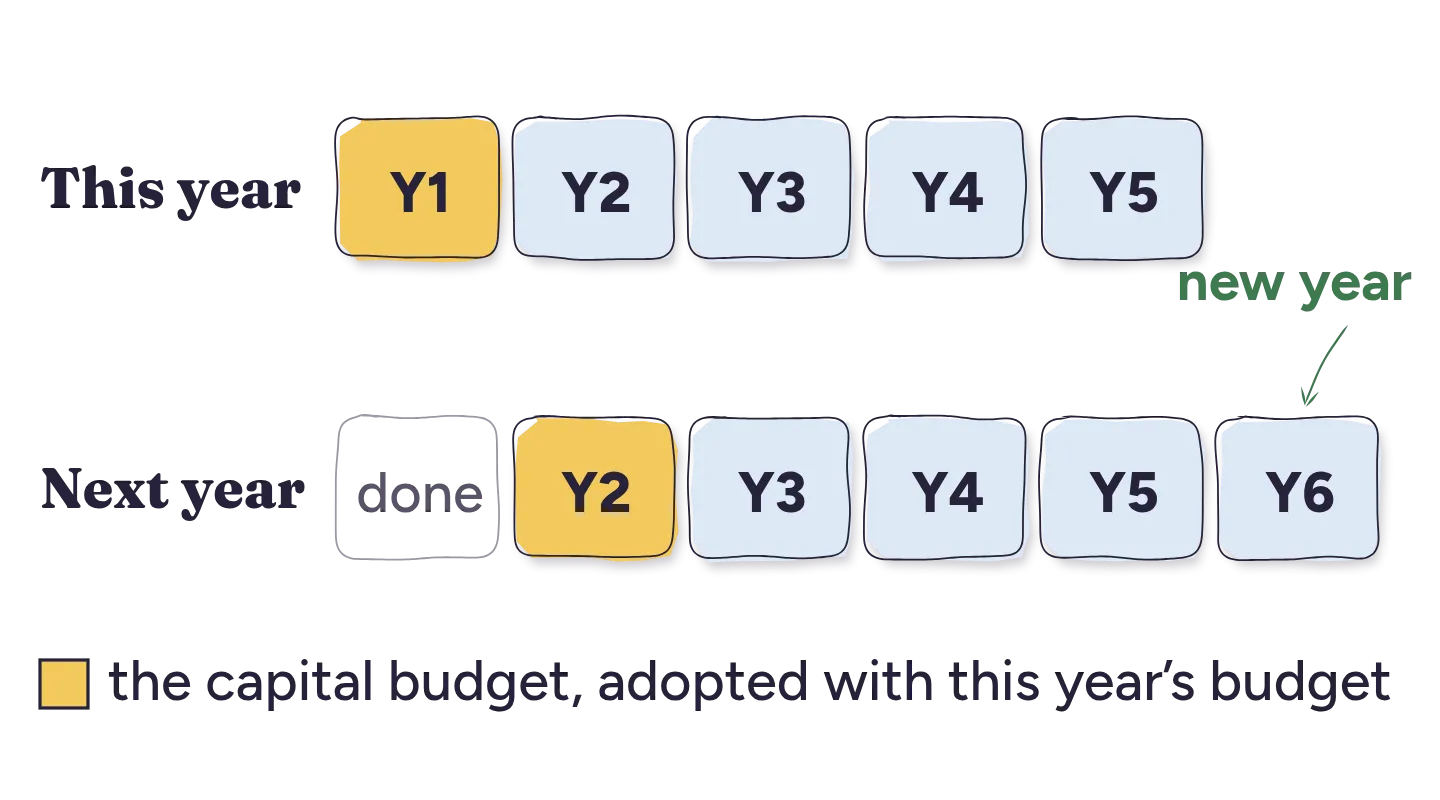
A capital improvements program (CIP) is a multi-year schedule (typically five or six years) of public capital projects: long-lived, high-cost physical investments such as roads, water and sewer lines, parks, fire stations, and libraries. For each project it lists the cost, timing, and funding sources.
- The first year of the CIP becomes the capital budget, adopted annually alongside the operating budget.
- The CIP is updated every year: completed projects drop off, a new final year is added, and priorities are revisited.
- In many jurisdictions the planning commission reviews the CIP for consistency with the comprehensive plan.
Capital versus operating spending: capital spending buys or builds assets that last many years; operating spending pays for ongoing services (salaries, maintenance, supplies). A new fire station is capital; the firefighters' salaries are operating costs, and every new facility creates ongoing operating costs the CIP should acknowledge.
8 more sections follow in the full lesson.
Key terms
- Capital improvements program (CIP): A multi-year schedule of capital projects with costs, timing, and funding.
- Capital budget: The first year of the CIP, adopted with the annual budget.
- Pay-as-you-go: Financing capital projects from current revenues.
- General obligation bond: A bond backed by the issuer's full faith, credit, and taxing power.
- Revenue bond: A bond repaid from the revenues of the financed facility or system.
- Bond rating: An assessment of the issuer's creditworthiness.
- Tax increment financing (TIF): Financing improvements with the growth in property tax revenue above a frozen base.
- Special assessment: A charge on properties that receive a special benefit from an improvement.
- Business improvement district (BID): A district funded by self-imposed assessments for supplemental services.
- Impact fee: A one-time charge on new development for capital facilities needed to serve it.
- Rational nexus: The required link between a fee, the need a development creates, and the benefit it receives.
- Value capture: Recovering part of the land value increase created by public investment.
- Life-cycle cost: The total cost of an asset over its useful life, including operation, maintenance, and replacement.
- Debt service: The annual payment of principal and interest on outstanding debt.
- Operating budget impact: The ongoing yearly cost a capital project adds once it's built.
Create an account to see the rest of this lesson
Every lesson and full-length practice exam is open to you. An account keeps your scores and progress in one place so you can see where to study next.
Just looking? The list of lessons and the sample questions are open to everyone.
Ready for exam-style questions?
The checkpoints in this lesson were written for it alone, so they never give away an exam question. To see how the Implementation domain is tested, take a full-length practice exam. It mixes all nine domains in exam proportions, and your results point you back to the lessons behind every question you miss.
Exams need an account, so your scores are saved. Create one to get started.