
Vision, goals, objectives, and policies
The plan hierarchy from vision to action, writing measurable objectives, drafting policy, building in an equity framework, and setting priorities.
Lesson 17 of 40 · about 22 minutes · Outline areas: 4.4 Formulating and drafting policies; 4.5 Vision, goal, objective, policy, and priority statements; 4.6 Objectives and actions within an equity framework
Learning objectives
- Put the plan hierarchy (vision, goal, objective, policy, action) in order and explain what each level does.
- Write a measurable objective and tell it apart from a goal.
- Draft clear policy language and choose directive words deliberately.
- Apply an equity lens to goals, objectives, and actions.
- Set priorities and translate vague values, such as "character," into measurable standards.
Key concepts
The plan hierarchy
Plans move from the general to the specific. The terms vary a little from plan to plan, but the logic doesn't:
| Level | What it is | Example |
|---|---|---|
| Vision | A shared, aspirational description of the community's desired long-range future | "In 2045, Riverton is a place where people of every age and income can live near their work, their schools, and the river." |
| Goal | A broad statement of a desired end state; not directly measurable | "Housing choices meet the needs of residents at all income levels." |
| Objective | A specific, measurable, usually time-bound target that moves toward a goal | "Permit 2,000 new homes affordable to households below 80% of area median income by 2035." |
| Policy | A statement of the course of action the jurisdiction commits to follow when it makes decisions | "The city shall allow duplexes and triplexes in all residential districts." |
| Action (implementation measure) | A specific task with a responsible party, timeline, and resources | "Planning Department: draft zoning amendments allowing duplexes and triplexes citywide; present to Council by June 2026." |
A quick test: a goal is broad, an objective is measurable, and a policy guides decisions. "Improve walkability" is a goal. "Increase the share of residents living within a ten-minute walk of a park from 60% to 80% by 2035" is an objective.
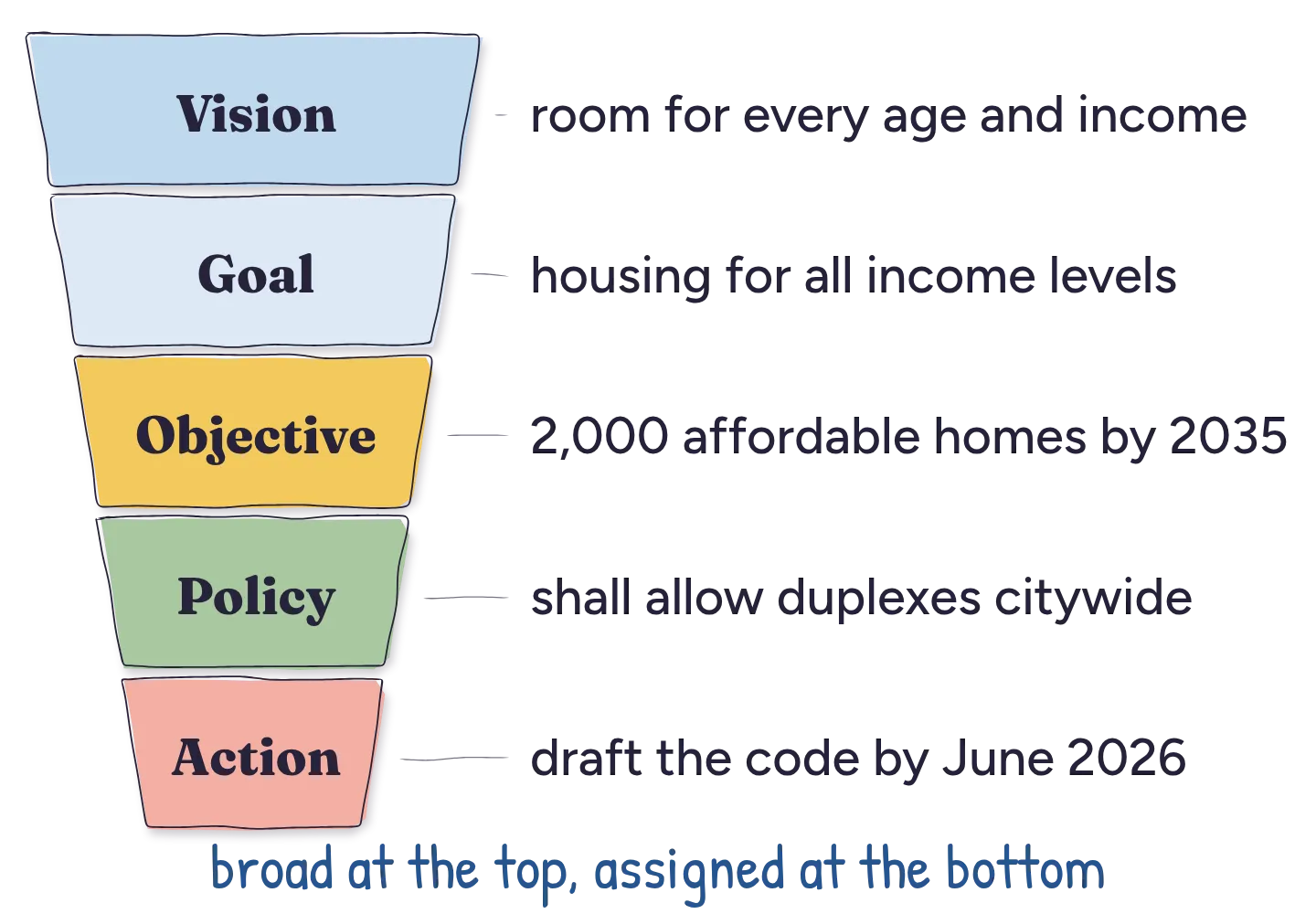
Builds one example from a vision statement down to an assigned action, so the difference between a goal, an objective, and a policy is easy to see.
6 more sections follow in the full lesson.
Key terms
- Vision: A shared description of the community's desired long-range future.
- Goal: A broad statement of a desired end state.
- Objective: A specific, measurable, time-bound target that advances a goal.
- Policy: A statement of the course of action a jurisdiction will follow in making decisions.
- Action (implementation measure): A specific task with an assigned party, timeline, and resources.
- SMART objective: One that is specific, measurable, achievable, relevant, and time-bound.
- Baseline: The measured starting value an objective is compared against.
- Equity lens: A set of questions examining who benefits, who is burdened, and who is included.
- Disaggregated data: Data broken out by subgroup or geography rather than reported only as a total.
- Priority statement: A statement ranking or sequencing actions.
- Impact-effort matrix: A chart that ranks actions by their benefit and the effort they require.
- Phasing: Assigning actions to short-, medium-, and long-term time frames.
Create an account to see the rest of this lesson
Every lesson and full-length practice exam is open to you. An account keeps your scores and progress in one place so you can see where to study next.
Just looking? The list of lessons and the sample questions are open to everyone.
Ready for exam-style questions?
The checkpoints in this lesson were written for it alone, so they never give away an exam question. To see how the Plan & Policy domain is tested, take a full-length practice exam. It mixes all nine domains in exam proportions, and your results point you back to the lessons behind every question you miss.
Exams need an account, so your scores are saved. Create one to get started.