
Scenario planning, fiscal impact, and consequence analysis
Comparing alternatives, scenario planning under uncertainty, buildable lands, fiscal impact methods, greenhouse gas inventories, impact assessments, and funding versus financing.
Lesson 18 of 40 · about 28 minutes · Outline areas: 4.9 Applying innovations and best practices; 4.10 Identifying and evaluating consequences; 4.11 Funding and financing considerations
Learning objectives
- Evaluate plan alternatives against goals using a transparent, weighted method.
- Explain when scenario planning is the right tool and how a scenario process works.
- Describe a buildable lands (land capacity) inventory and how it's compared with projected demand.
- Compare fiscal impact analysis methods, including the per capita multiplier.
- Explain what health impact assessments and other impact assessments add, and when to do them.
- Distinguish funding from financing and match funding sources to the plan's actions.
- Describe how a local greenhouse gas inventory is built, and how pilots and best practices can be tested before full adoption.
Key concepts
Comparing alternatives
Once a planning process has two or more alternatives, it needs a fair way to compare them. Good evaluation is:
- tied to the plan's goals: each goal becomes one or more evaluation criteria;
- measurable where possible: acres of farmland consumed, households within a 10-minute walk of transit, infrastructure cost, vehicle miles traveled;
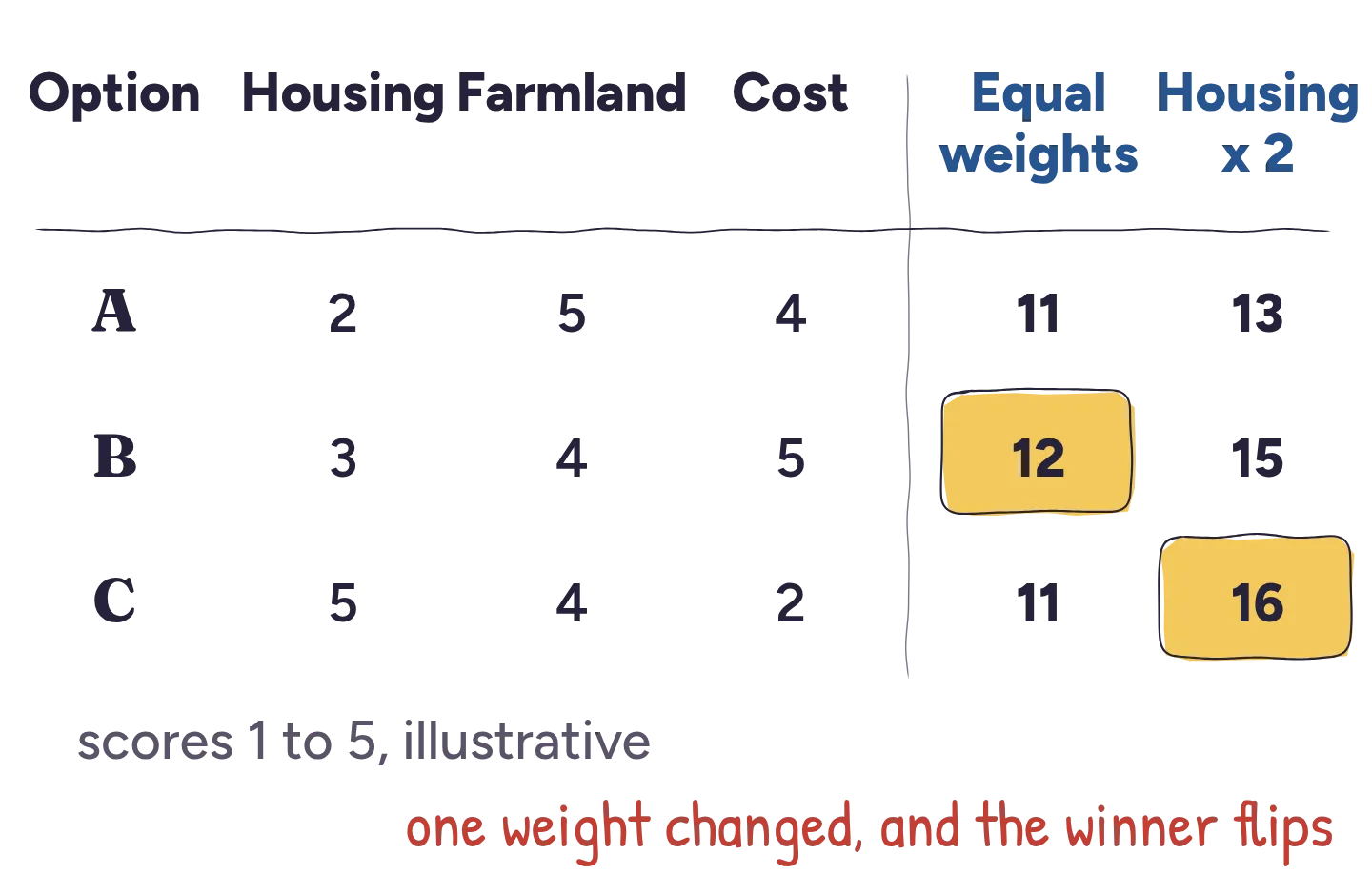
- transparent about weighting: if housing affordability counts twice as much as traffic delay, say so; and
- honest about uncertainty.
A goals-achievement matrix lays out alternatives in columns and criteria in rows, scoring how well each alternative advances each goal, sometimes with weights. The method is associated with Morris Hill, who proposed it in 1968. A related classic, Nathaniel Lichfield's planning balance sheet, lists the costs and benefits of each alternative separately for each group affected (residents, businesses, the city, future occupants), so decision-makers can see who gains and who loses rather than only the net total. Multi-criteria analysis is the broader family of methods for this. Sensitivity analysis tests whether the preferred alternative changes when weights or assumptions change. If a small change in weights flips the result, decision-makers should know that.
8 more sections follow in the full lesson.
Key terms
- Goals-achievement matrix: A table scoring alternatives against plan goals, often with weights.
- Planning balance sheet: An evaluation that lists each alternative's costs and benefits by affected group.
- Multi-criteria analysis: Methods for comparing alternatives across several criteria.
- Sensitivity analysis: Testing how results change when assumptions or weights change.
- Scenario planning: Developing several plausible futures to test the robustness of strategies.
- Robust strategy: A strategy that performs acceptably across multiple scenarios.
- Buildable lands inventory: An estimate of land available and suitable for development, and its capacity.
- Redevelopable land: Developed land whose improvements are worth little relative to the land, making redevelopment likely.
- Fiscal impact analysis: An estimate of the public costs and revenues of development.
- Per capita multiplier method: A fiscal impact method using average cost per resident.
- Marginal cost: The added cost of serving additional development.
- Greenhouse gas inventory: An accounting of emissions by sector and source, used as a baseline.
- Health impact assessment (HIA): A structured estimate of how a proposal will affect health and its distribution, with recommendations.
- Funding: The source that ultimately pays for an action.
- Financing: Spreading a cost over time, usually by borrowing, to be repaid from a funding source.
- Pilot project: A temporary or small-scale trial used to test an idea.
Create an account to see the rest of this lesson
Every lesson and full-length practice exam is open to you. An account keeps your scores and progress in one place so you can see where to study next.
Just looking? The list of lessons and the sample questions are open to everyone.
Ready for exam-style questions?
The checkpoints in this lesson were written for it alone, so they never give away an exam question. To see how the Plan & Policy domain is tested, take a full-length practice exam. It mixes all nine domains in exam proportions, and your results point you back to the lessons behind every question you miss.
Exams need an account, so your scores are saved. Create one to get started.