
Comprehensive plans, elements, and consistency
What a comprehensive plan is (and isn’t), typical elements, area and functional plans, and the consistency doctrine.
Lesson 16 of 40 · about 22 minutes · Outline areas: 4.3 Familiarity with states' and federal laws; 4.12 Community character and form; 4.14 Conversance with related disciplines
Learning objectives
- Define a comprehensive plan and explain how it differs from a zoning ordinance.
- List the elements commonly found in comprehensive plans, and explain what makes a plan internally consistent.
- Explain the consistency doctrine and the range of legal weight plans carry across states.
- Distinguish comprehensive, area, functional, regional, and strategic plans, and choose the right one for a situation.
- Describe how community character and form are addressed in a plan.
Key concepts
What a comprehensive plan is
A comprehensive plan (also called a general plan or master plan) is a community's long-range policy guide for its physical development. It's:
- comprehensive: it covers the whole jurisdiction and all the topics that shape physical development;
- long-range: it typically looks 20 years ahead;
- general: it sets direction and policy rather than lot-by-lot rules; and
- officially adopted by the governing body after public hearings.
A comprehensive plan is not a regulation. The zoning ordinance is the regulation that implements the plan. The plan says where the community wants housing, jobs, parks, and infrastructure; the zoning code sets the rules that apply to each parcel today.
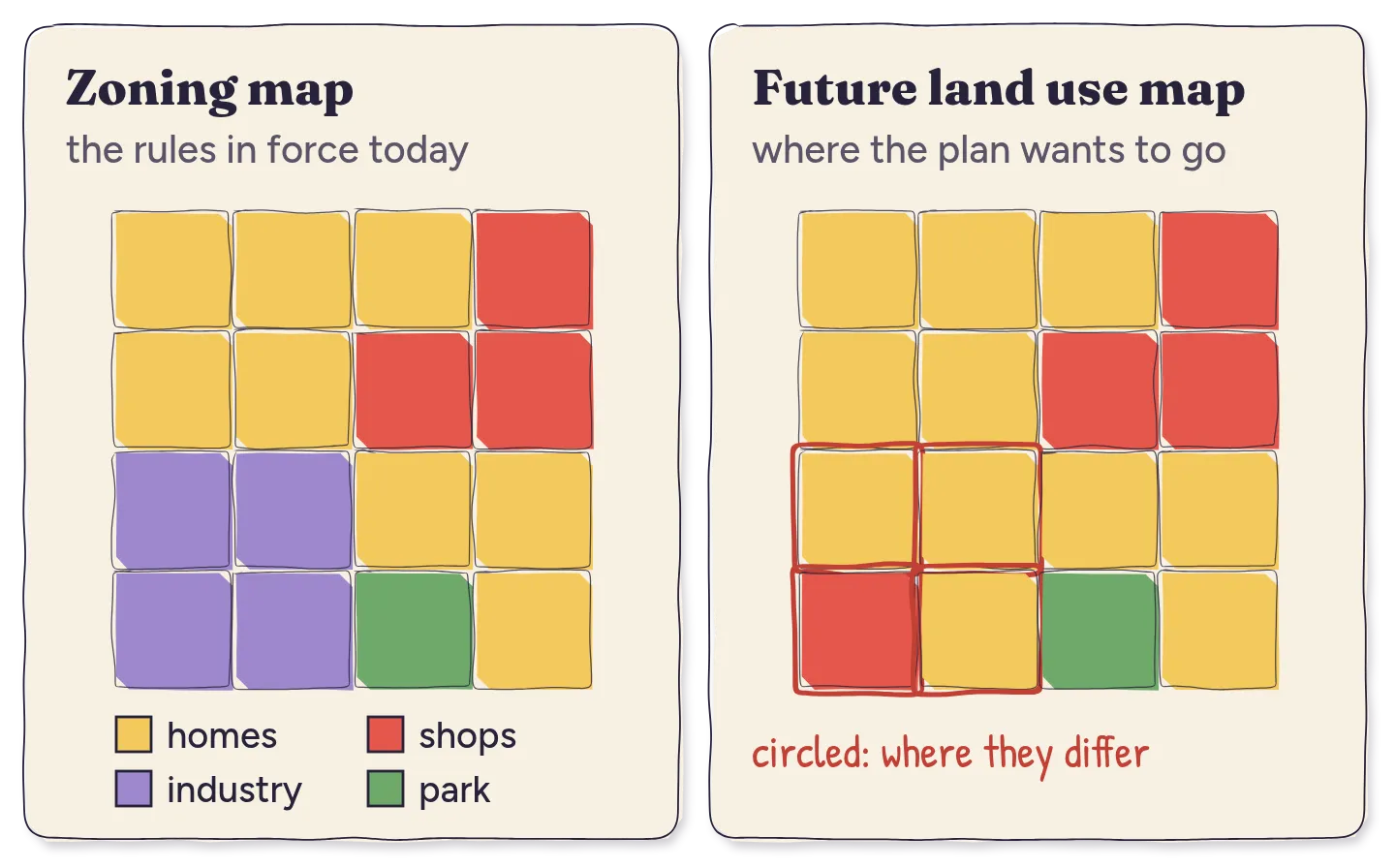
A key tool inside the plan is the future land use map, which shows the intended pattern of land uses over the plan horizon. It's often confused with the zoning map, which shows the regulations in force now. The two will differ where the plan anticipates change.
6 more sections follow in the full lesson.
Key terms
- Comprehensive plan: An adopted, long-range, general policy guide for a community's physical development.
- Future land use map: The plan's map of intended land use over the planning horizon.
- Zoning map: The official map of zoning districts in force now.
- Element: A topical chapter of a comprehensive plan.
- Internal consistency: Agreement among a plan's elements, maps, and policies.
- Consistency doctrine: The requirement in some states that zoning and approvals conform to the adopted plan.
- Area (small area) plan: A detailed plan for a neighborhood, corridor, district, or station area.
- Functional plan: A plan for a single system, such as transportation or parks.
- Capital improvements element: The plan element linking policies to facility investments and financing.
- Community character: The distinctive physical qualities that give a place its identity.
Create an account to see the rest of this lesson
Every lesson and full-length practice exam is open to you. An account keeps your scores and progress in one place so you can see where to study next.
Just looking? The list of lessons and the sample questions are open to everyone.
Ready for exam-style questions?
The checkpoints in this lesson were written for it alone, so they never give away an exam question. To see how the Plan & Policy domain is tested, take a full-length practice exam. It mixes all nine domains in exam proportions, and your results point you back to the lessons behind every question you miss.
Exams need an account, so your scores are saved. Create one to get started.