
Federal laws and programs that shaped planning
Housing acts, the Interstate highway program and the transportation laws that followed, NEPA, civil rights, fair housing and fair lending law, and the federal grant programs planners still use.
Lesson 10 of 40 · about 25 minutes · Outline areas: 2.3 Foundational legal principles; 4.3 Familiarity with states' and federal laws
Learning objectives
- Describe the major federal housing laws from 1934 to 1974 and what each changed.
- Explain the purpose and effects of the Federal-Aid Highway Act of 1956 and later surface transportation laws.
- Summarize NEPA and the major environmental statutes planners encounter.
- Identify the civil rights, fair housing, and accessibility laws that shape planning practice.
- Recognize the federal grant programs planners still use and match each to its purpose.
Key concepts
Land use regulation is mostly a state and local power, but federal money and federal law have shaped American communities as much as any zoning code. The exam expects you to connect each major law to its core purpose.
Housing and community development
| Law or program | What it did |
|---|---|
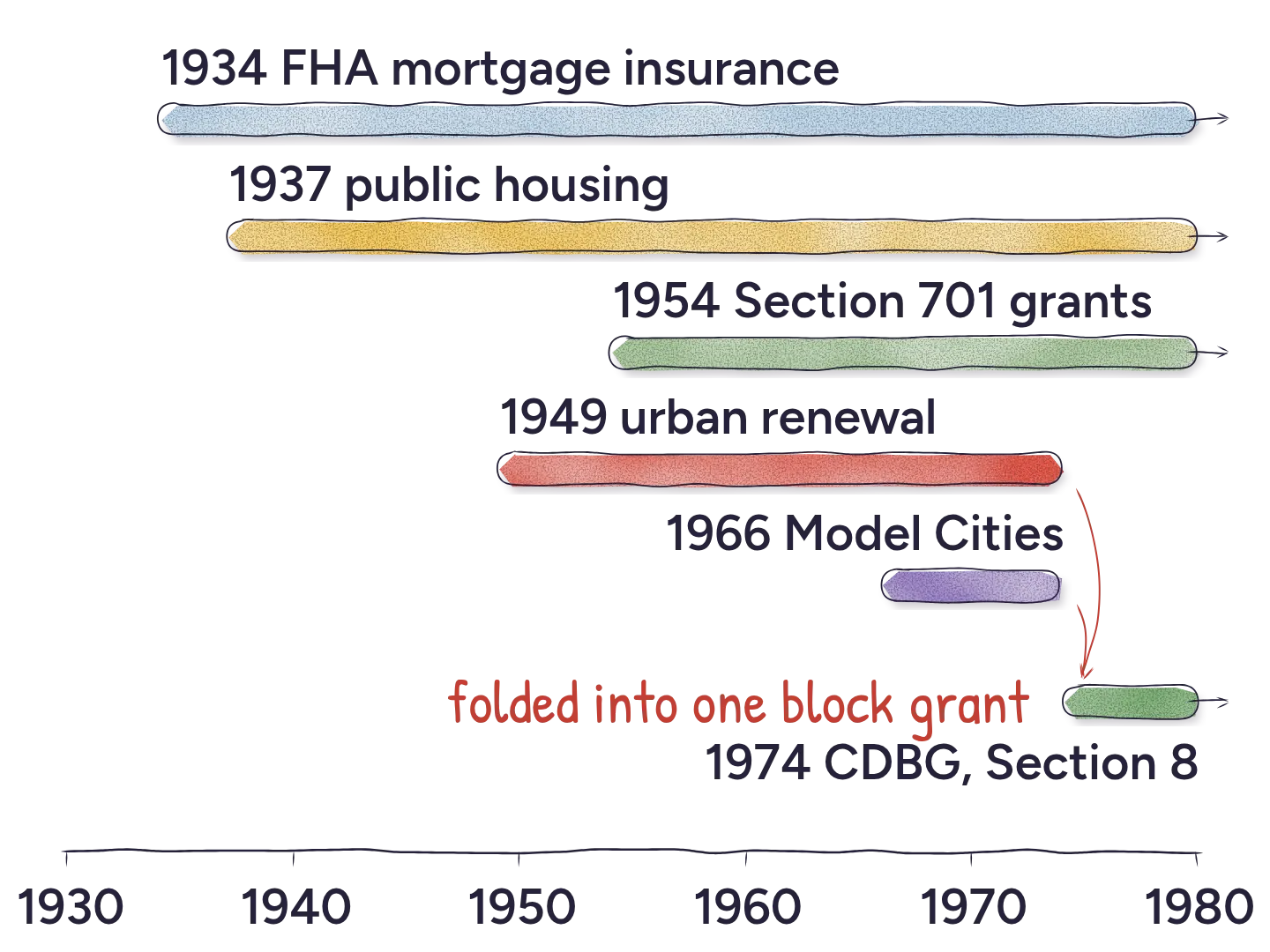
| National Housing Act of 1934 | Created the Federal Housing Administration (FHA), which insured long-term, low-down-payment mortgages. It transformed home buying, and its underwriting standards favored new suburban, racially segregated development. |
| Housing Act of 1937 | Created the federal public housing program, run through local housing authorities. |
| Housing Act of 1949 | Declared the goal of "a decent home and a suitable living environment for every American family" and launched urban renewal (Title I), which funded land clearance and redevelopment. |
| Housing Act of 1954 | Broadened urban renewal toward rehabilitation and created the Section 701 program of federal grants for local, metropolitan, and state planning. It required a "workable program," including a comprehensive plan, for renewal funding. |
| Model Cities (1966) | The Demonstration Cities and Metropolitan Development Act funded coordinated, comprehensive antipoverty and neighborhood improvement efforts in selected cities, with resident participation. |
| Housing and Community Development Act of 1974 | Consolidated categorical programs, including urban renewal and Model Cities, into the flexible Community Development Block Grant (CDBG) and created the Section 8 rental assistance program. |
| HOPE VI (1992) | Funded demolition of severely distressed public housing and its replacement with mixed-income communities, often with fewer deeply affordable units than before. |
| Choice Neighborhoods (2010) | Succeeded HOPE VI, pairing public and assisted housing redevelopment with investment in the surrounding neighborhood. |
5 more sections follow in the full lesson.
Key terms
- FHA: The Federal Housing Administration, created in 1934 to insure mortgages.
- Urban renewal: The federal land clearance and redevelopment program launched by the Housing Act of 1949.
- Section 701: The 1954 program of federal grants for local and regional planning.
- CDBG: The Community Development Block Grant, a flexible federal grant created in 1974 for housing, facilities, and economic development that primarily benefits low- and moderate-income people.
- Highway Trust Fund: The fuel-tax fund created in 1956 to finance the Interstate system.
- 3C process: The continuing, comprehensive, and cooperative metropolitan transportation planning process.
- NEPA: The National Environmental Policy Act, which requires environmental review of major federal actions.
- Environmental Impact Statement (EIS): A detailed NEPA analysis for major federal actions with significant effects.
- Nonattainment area: A region that fails a national ambient air quality standard.
- Section 404: The Clean Water Act permit program for filling wetlands and waters.
- Fair Housing Act: The 1968 law prohibiting housing discrimination; disability and familial status were added in 1988.
- Affirmatively furthering fair housing: The Fair Housing Act duty to take meaningful steps to overcome segregation and foster inclusive communities.
- Performance-based planning: Planning organized around national goals, measures, and targets, required since MAP-21 (2012).
- HOPE VI: A 1992 federal program that replaced distressed public housing with mixed-income communities.
- Community Reinvestment Act: A 1977 law requiring banks to serve the credit needs of their whole communities, including low- and moderate-income areas.
Create an account to see the rest of this lesson
Every lesson and full-length practice exam is open to you. An account keeps your scores and progress in one place so you can see where to study next.
Just looking? The list of lessons and the sample questions are open to everyone.
Ready for exam-style questions?
The checkpoints in this lesson were written for it alone, so they never give away an exam question. To see how the Fundamentals domain is tested, take a full-length practice exam. It mixes all nine domains in exam proportions, and your results point you back to the lessons behind every question you miss.
Exams need an account, so your scores are saved. Create one to get started.