
Environmental planning, hazards, and resilience
Environmental review, brownfields, the Endangered Species Act and water quality law, floodplains and the NFIP, hazard mitigation and disaster recovery, climate mitigation and adaptation, and green infrastructure.
Lesson 32 of 40 · about 31 minutes · Outline areas: 8.7 Hazard mitigation and resiliency planning; 8.8 Natural resources planning
Learning objectives
- Walk through the NEPA process from categorical exclusion to record of decision.
- Explain brownfields and the purpose and contents of a Phase I environmental site assessment.
- Describe floodplain basics, the National Flood Insurance Program, and hazard mitigation planning under the Disaster Mitigation Act of 2000.
- Distinguish climate mitigation from adaptation, and explain resilience and managed retreat.
- Apply green infrastructure, wetland protection, and wildland-urban interface strategies.
- Summarize the Endangered Species Act, NPDES permits and TMDLs, coastal zone management, and Superfund as they affect local planning.
- Explain how communities plan for recovery before and after a disaster.
Key concepts
Environmental review under NEPA
The National Environmental Policy Act requires federal agencies to consider environmental effects before acting. It applies to projects with a federal nexus: federal funding, permits, or land. The process scales with a project's significance:
- Categorical exclusion (CE): actions that normally have no significant effects (for example, many minor repairs) skip detailed review.
- Environmental assessment (EA): a concise analysis to decide whether effects could be significant. It ends in either a finding of no significant impact (FONSI) or a decision to prepare an EIS.
- Environmental impact statement (EIS): required for major federal actions significantly affecting the quality of the human environment. The steps are a notice of intent, scoping (defining the issues and alternatives, with public input), a draft EIS analyzing a reasonable range of alternatives, including no action, a public comment period, a final EIS, and a record of decision (ROD).
NEPA is procedural: it requires study and disclosure, not the least harmful choice. Many states have their own environmental review laws, some of which reach local decisions.
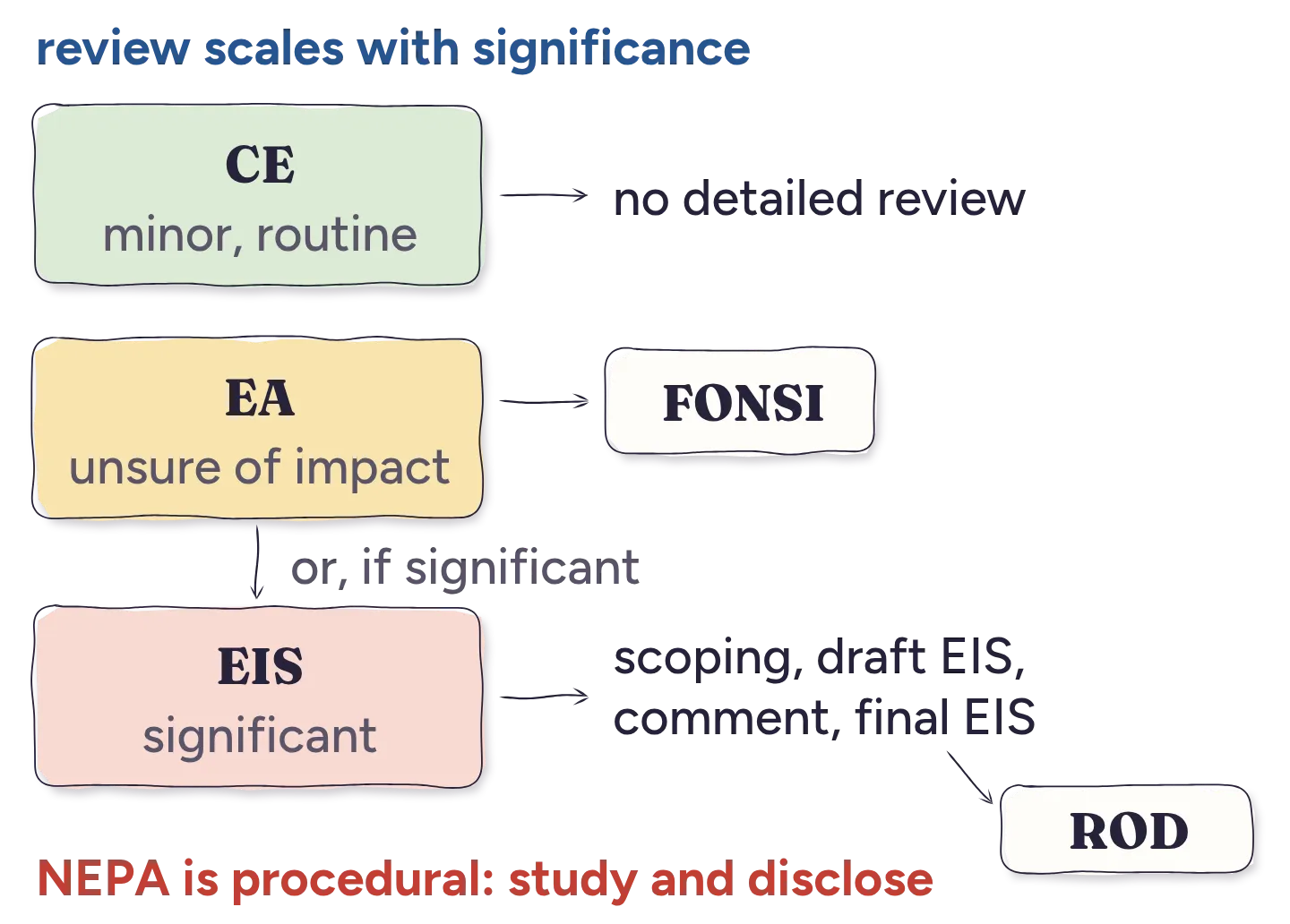
A decision-tree walkthrough of which level of review a project needs and what each ends in (a FONSI or a record of decision).
9 more sections follow in the full lesson.
Key terms
- Categorical exclusion: A class of actions that normally needs no detailed NEPA analysis.
- Environmental assessment (EA): A concise NEPA analysis to determine significance.
- FONSI: A finding of no significant impact.
- Environmental impact statement (EIS): A detailed NEPA analysis for major federal actions with significant effects.
- Record of decision (ROD): The document announcing the agency's decision after an EIS.
- Brownfield: A property whose reuse is complicated by potential contamination.
- Phase I ESA: A records review, site reconnaissance, and interviews to identify contamination risks.
- Mitigation sequence: Avoid, then minimize, then compensate for environmental impacts.
- Green stormwater infrastructure: Systems that manage rainfall where it falls.
- Base flood (100-year flood): A flood with a 1% chance of occurring in any year.
- NFIP: The National Flood Insurance Program.
- Hazard mitigation plan: A plan assessing hazard risk and setting actions to reduce it.
- Climate adaptation: Actions preparing for expected climate impacts.
- Climate mitigation: Actions reducing greenhouse gas emissions.
- Managed retreat: Planned relocation away from high-risk areas.
- Wildland-urban interface (WUI): The zone where development meets wildland vegetation.
- Habitat conservation plan (HCP): A plan that supports an incidental take permit under ESA Section 10 by minimizing and mitigating harm to a listed species.
- Total maximum daily load (TMDL): The most of a pollutant an impaired water body can receive and still meet standards.
- NPDES: The Clean Water Act permit program for discharges from point sources.
- Ecosystem services: Benefits nature provides, such as flood storage, water filtration, and cooling.
- Pre-disaster recovery plan: A plan, adopted before a disaster, for how the community will make recovery decisions.
- Buyout: Voluntary public purchase of hazard-prone property, which is then kept as open space.
Create an account to see the rest of this lesson
Every lesson and full-length practice exam is open to you. An account keeps your scores and progress in one place so you can see where to study next.
Just looking? The list of lessons and the sample questions are open to everyone.
Ready for exam-style questions?
The checkpoints in this lesson were written for it alone, so they never give away an exam question. To see how the Areas of Practice domain is tested, take a full-length practice exam. It mixes all nine domains in exam proportions, and your results point you back to the lessons behind every question you miss.
Exams need an account, so your scores are saved. Create one to get started.