
Housing and community development
Affordability and cost burden, area median income, LIHTC and vouchers, CDBG, fair housing, fair share, missing middle and manufactured housing, rent regulation, and displacement.
Lesson 31 of 40 · about 29 minutes · Outline areas: 8.11 Housing planning
Learning objectives
- Apply the cost-burden standard and HUD's area median income categories.
- Describe the parts of a housing needs assessment.
- Explain how LIHTC, Housing Choice Vouchers, CDBG, HOME, and Housing First work.
- Summarize the Fair Housing Act, affirmatively furthering fair housing, and the key cases (Inclusive Communities, Edmonds, Mount Laurel).
- Use supply, preservation, and tenant-protection tools, including missing middle housing, ADUs, and manufactured housing, to address affordability and displacement.
- Distinguish rent control from rent stabilization and weigh their tradeoffs.
Key concepts
Measuring affordability
The most widely used planning measure: a household is cost-burdened when it pays more than 30% of gross income for housing costs, and severely cost-burdened above 50%. Housing costs include rent plus utilities for renters, and mortgage, property taxes, insurance, and utilities for owners. See Implementation math for worked calculations.
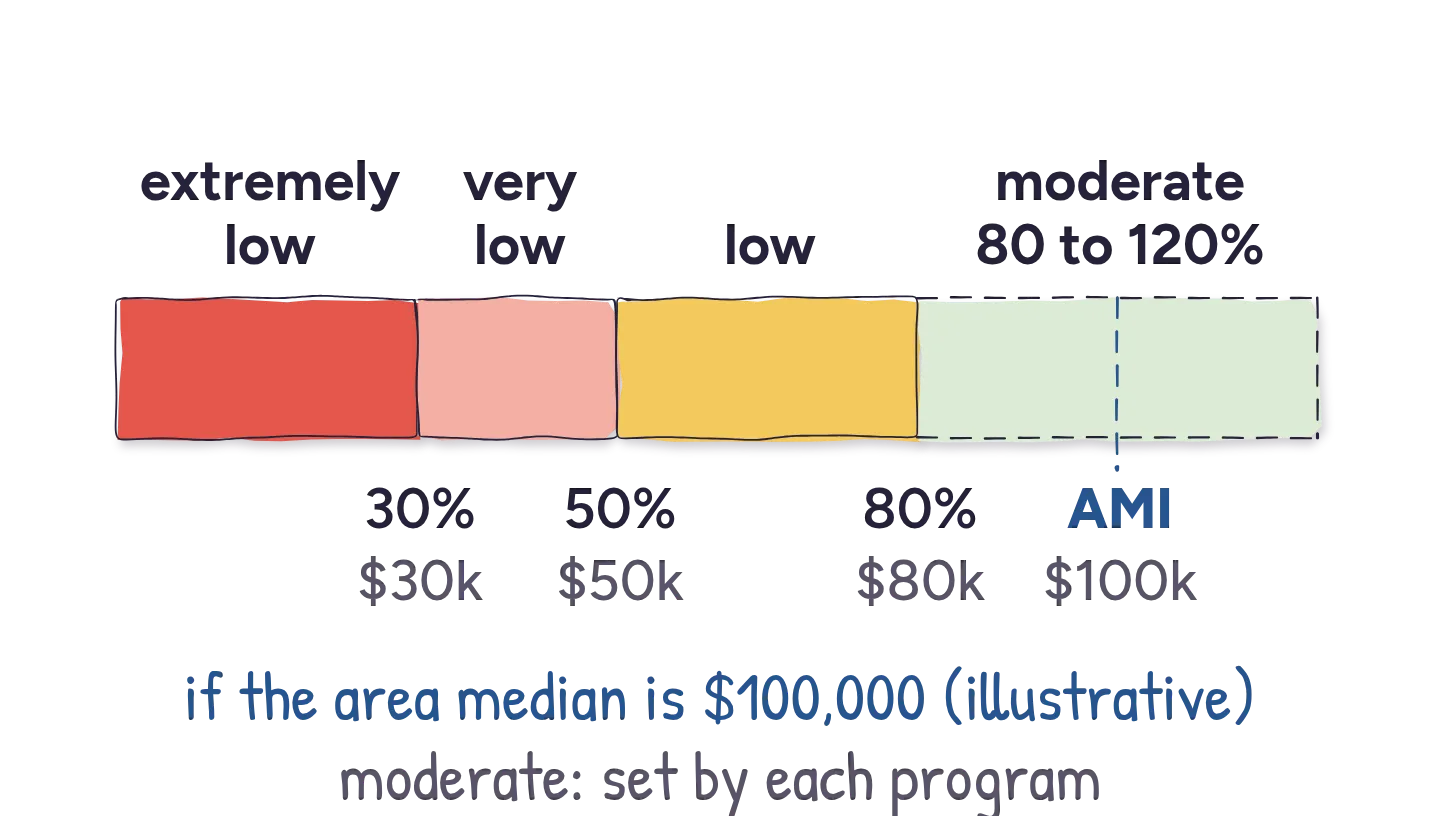
Area median income (AMI) anchors most affordability programs. HUD publishes income limits for each area, adjusted for household size:
| Category | Income |
|---|---|
| Extremely low income | At or below 30% of AMI |
| Very low income | At or below 50% of AMI |
| Low income | At or below 80% of AMI |
| Moderate income | Commonly 80–120% of AMI (defined locally or by program) |
7 more sections follow in the full lesson.
Key terms
- Cost burden: Paying more than 30% of gross income for housing; severe cost burden is more than 50%.
- Area median income (AMI): The median household income for an area, used to set program eligibility.
- Tenure: Whether a household owns or rents its home.
- Housing needs assessment: An analysis of current and projected housing needs by income and household type.
- LIHTC: The federal Low-Income Housing Tax Credit, allocated by states to affordable rental developments.
- Housing Choice Voucher: A tenant-based federal rental subsidy.
- CDBG: The flexible federal Community Development Block Grant.
- HOME: A federal block grant dedicated to affordable housing.
- Housing First: Providing permanent housing without preconditions.
- Disparate impact: An unjustified discriminatory effect of a facially neutral policy.
- Affirmatively furthering fair housing (AFFH): The duty to take meaningful action to overcome segregation.
- Fair share: A municipality's obligation to accommodate its portion of regional affordable housing need.
- Missing middle housing: House-scale buildings containing multiple units.
- Accessory dwelling unit (ADU): A secondary home on the same lot as a primary dwelling.
- Community land trust (CLT): A nonprofit that holds land in trust to keep housing permanently affordable.
- HUD Code: The federal construction standard for manufactured homes, in effect since 1976.
- Rent stabilization: Limits on annual rent increases for existing tenants, often tied to inflation.
- Vacancy decontrol: A rule letting a regulated unit's rent reset when a tenant moves out.
Create an account to see the rest of this lesson
Every lesson and full-length practice exam is open to you. An account keeps your scores and progress in one place so you can see where to study next.
Just looking? The list of lessons and the sample questions are open to everyone.
Ready for exam-style questions?
The checkpoints in this lesson were written for it alone, so they never give away an exam question. To see how the Areas of Practice domain is tested, take a full-length practice exam. It mixes all nine domains in exam proportions, and your results point you back to the lessons behind every question you miss.
Exams need an account, so your scores are saved. Create one to get started.