
Economic development
Economic base theory and multipliers, location quotients in practice, clusters, retail analysis, economic impact analysis, incentives, and place-based tax programs.
Lesson 33 of 40 · about 24 minutes
Learning objectives
- Explain economic base theory and calculate and apply an economic base multiplier.
- Use location quotients to identify basic industries, and recognize their assumptions.
- Describe cluster-based strategies and the main economic development approaches: retention, attraction, entrepreneurship, and workforce development.
- Calculate and interpret retail capture and leakage.
- Distinguish direct, indirect, and induced effects in an economic impact analysis.
- Evaluate incentives and place-based programs, including TIF, Opportunity Zones, and business improvement districts.
Key concepts
Economic base theory
Economic base theory divides a local economy into two sectors:
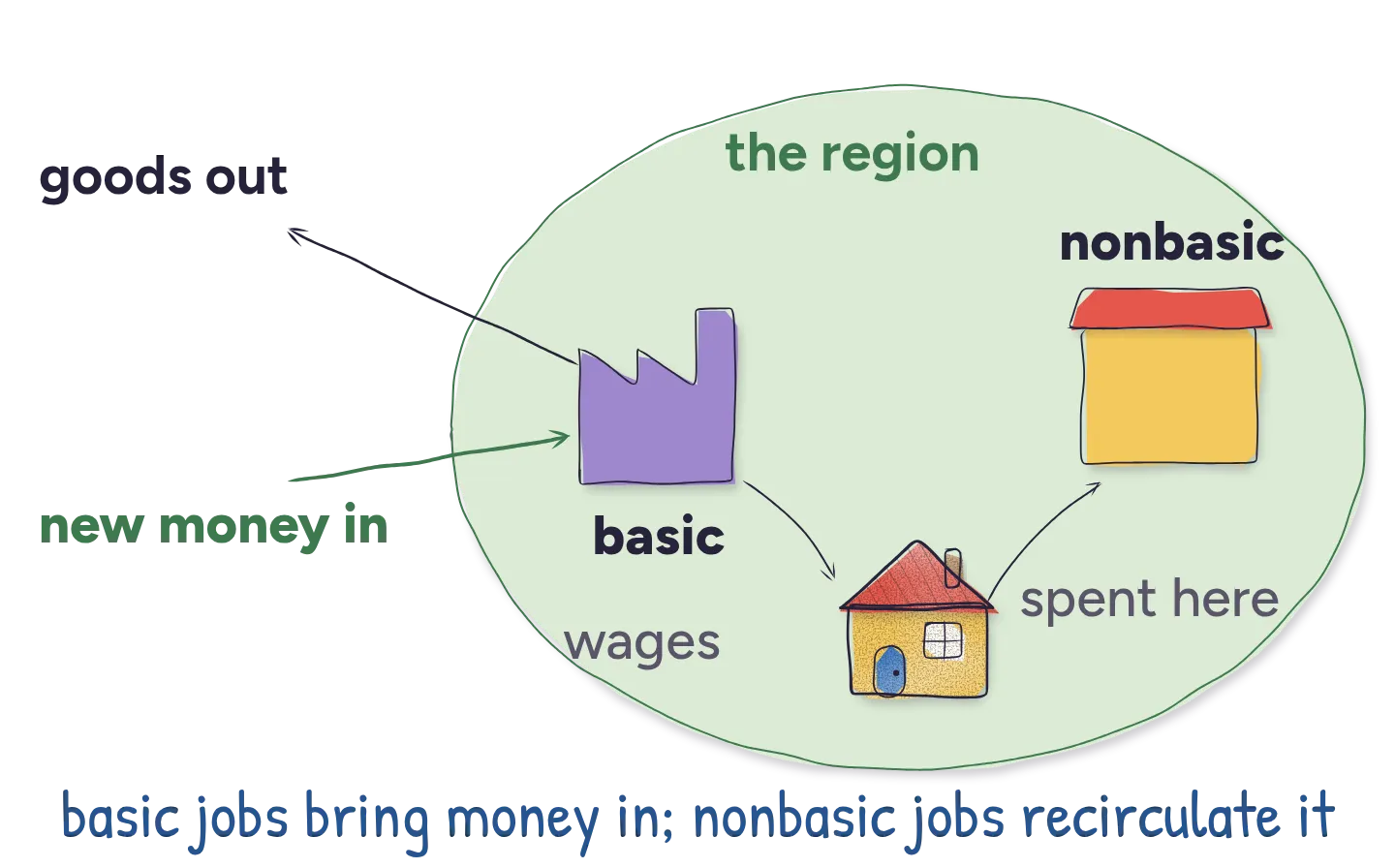
- Basic (export) activity sells goods and services to customers outside the local economy: a factory shipping products nationally, a university enrolling students from elsewhere, a regional hospital, tourism. It brings new money in.
- Nonbasic (local-serving) activity sells to local residents and businesses: grocery stores, barbers, local restaurants, dentists. It recirculates money already in the economy.
The theory holds that regional growth is driven principally by basic industries: when they grow, the new income they bring in supports more nonbasic jobs.
8 more sections follow in the full lesson.
Key terms
- Economic base theory: The theory that basic (export) industries drive regional growth.
- Basic (export) sector: Activity selling to customers outside the local economy.
- Nonbasic (local-serving) sector: Activity selling to local customers.
- Economic base multiplier: Total employment divided by basic employment.
- Location quotient: The ratio of an industry's local employment share to its national share.
- Cluster: A concentration of interconnected firms, suppliers, and institutions in a related field.
- Business retention and expansion (BRE): Programs that help existing businesses stay and grow.
- Trade area: The area from which a business or center draws most customers.
- Leakage: Resident spending that goes to stores outside the trade area.
- Capture rate: The share of trade-area spending captured by local businesses.
- Clawback: A provision requiring repayment of incentives if performance targets aren't met.
- Opportunity Zone: A designated low-income tract where qualified investments receive capital gains tax benefits.
- Economic gardening: Growing an area's economy by helping existing local firms expand.
- Direct effects: The jobs and spending of a project itself.
- Indirect effects: Added activity at local suppliers to a project.
- Induced effects: Added activity from workers spending their wages locally.
- Substitution effect: Local spending that shifts from one local business to another rather than adding new spending.
Create an account to see the rest of this lesson
Every lesson and full-length practice exam is open to you. An account keeps your scores and progress in one place so you can see where to study next.
Just looking? The list of lessons and the sample questions are open to everyone.
Ready for exam-style questions?
The checkpoints in this lesson were written for it alone, so they never give away an exam question. To see how the Areas of Practice domain is tested, take a full-length practice exam. It mixes all nine domains in exam proportions, and your results point you back to the lessons behind every question you miss.
Exams need an account, so your scores are saved. Create one to get started.