
Managing a planning agency
Forms of government, organizational structures, budget formats and fees, performance measures, hiring and supervising staff, public records and open meetings, and internal controls.
Lesson 27 of 40 · about 27 minutes · Outline areas: 6.2 Internal organizational management; 6.4 Mentoring and motivating staff; 6.5 Results-oriented management and accountability
Learning objectives
- Explain where a planning agency sits in council-manager and mayor-council governments.
- Compare functional, matrix, and team-based organizational structures, and address silos.
- Distinguish line-item, program, performance, and zero-based budgets, and explain how development fees recover costs.
- Classify performance measures as inputs, outputs, efficiency, or outcomes, and use them in results-oriented management.
- Apply sound hiring and supervision practices, and follow open-meetings and public-records requirements.
- Explain internal controls and audits that protect public funds.
Key concepts
Where planning sits in government
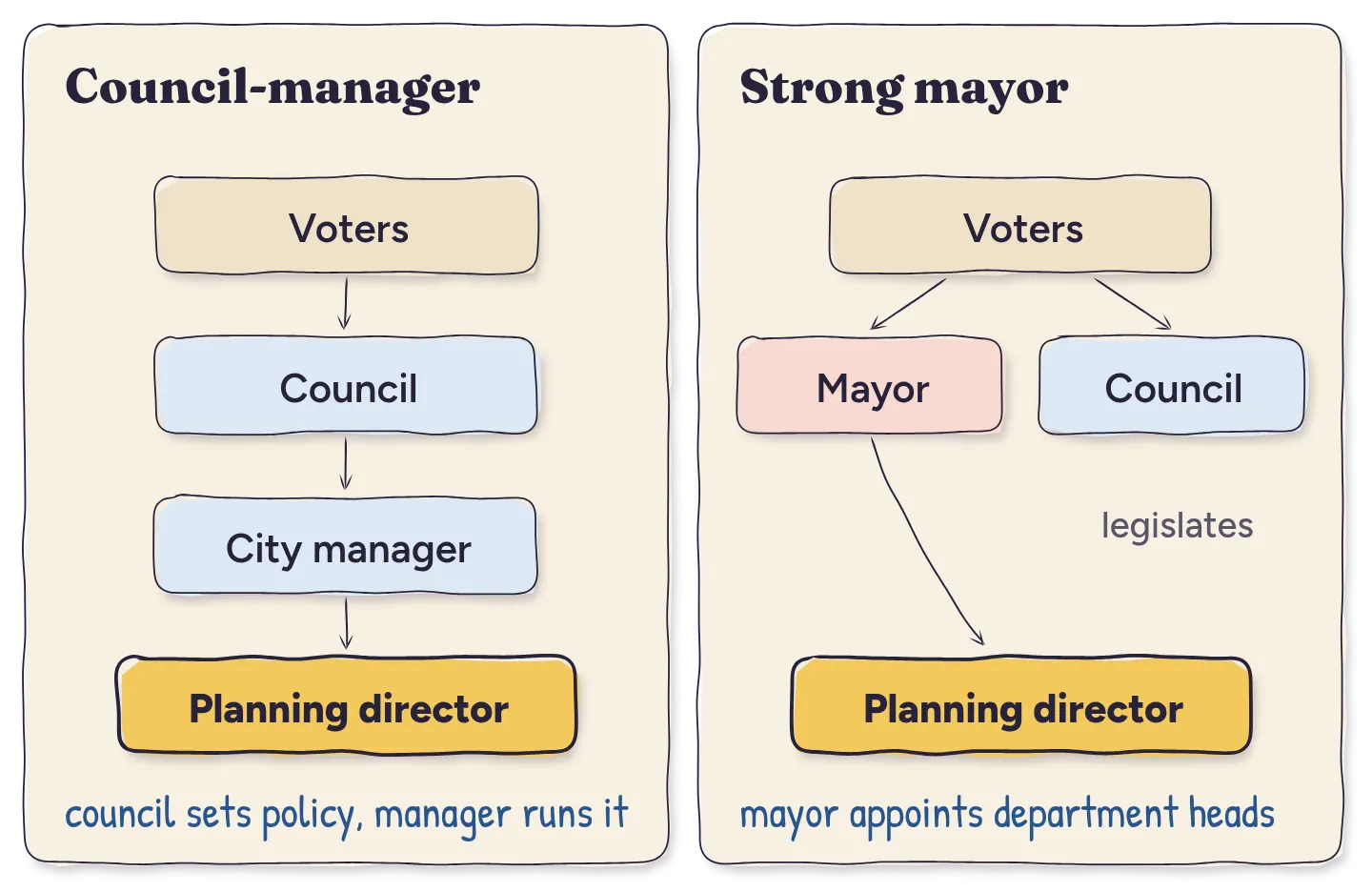
- In the council-manager form, an elected council sets policy and appoints a professional city (or county) manager who runs day-to-day operations. The planning director typically reports to the manager.
- In the mayor-council form, an elected mayor serves as chief executive. In a "strong mayor" system, the mayor appoints department heads, so the planning director reports to the mayor. In a "weak mayor" system, the council holds more administrative power.
- Planning commissions are appointed citizen bodies that advise the governing body on plans and regulations and may make some decisions directly. Historically some commissions directed planning staff; today most planning staff sit in an executive department that also supports the commission.
Planning departments are often combined with building, code enforcement, economic development, or housing into a community development department.
9 more sections follow in the full lesson.
Key terms
- Council-manager form: A government in which an elected council appoints a professional manager to run operations.
- Mayor-council form: A government with an elected mayor as chief executive.
- Functional organization: Staff grouped by specialized function.
- Matrix organization: Staff reporting to both a functional manager and a project manager.
- Silo: A unit that operates in isolation from others.
- Line-item budget: A budget organized by object of expenditure.
- Program budget: A budget organized by service or program.
- Performance budget: A budget linking spending to workload and results.
- Zero-based budgeting: A method requiring every expenditure to be justified from zero each cycle.
- Output measure: A count of work produced.
- Outcome measure: A measure of results in the community.
- Progressive discipline: A stepwise approach to addressing performance problems.
- Open-meetings law: A law requiring public bodies to meet openly with notice.
- Public-records law: A law giving the public access to government records, subject to exemptions.
- Cost recovery: Setting fees to cover some or all of the cost of providing a service.
- Enterprise fund: A separate fund for a service paid for mainly by its own fees.
- Merit (civil service) system: Hiring and promotion based on qualifications, protected from political influence.
- Structured interview: An interview asking every candidate the same job-related questions, scored against set criteria.
- Succession planning: Preparing staff to fill key roles before they're vacant.
- Internal controls: Procedures, such as separation of duties, that prevent errors and misuse.
- Single audit: An audit of a government's federal award programs, required above a spending threshold.
Create an account to see the rest of this lesson
Every lesson and full-length practice exam is open to you. An account keeps your scores and progress in one place so you can see where to study next.
Just looking? The list of lessons and the sample questions are open to everyone.
Ready for exam-style questions?
The checkpoints in this lesson were written for it alone, so they never give away an exam question. To see how the Administration domain is tested, take a full-length practice exam. It mixes all nine domains in exam proportions, and your results point you back to the lessons behind every question you miss.
Exams need an account, so your scores are saved. Create one to get started.