
Equitable, inclusive, and accessible engagement
Reaching people who are usually left out, equity analysis, language access, culturally appropriate communication, and accessible digital media.
Lesson 12 of 40 · about 23 minutes · Outline areas: 3.2 Nondiscriminatory and accessible electronic media; 3.5 Social justice; 3.6 Culturally appropriate communication
Learning objectives
- Identify the barriers that keep people out of planning processes and the practical steps that remove them.
- Distinguish procedural, distributive, and structural equity and apply them to a planning decision.
- Use an equity analysis, with disaggregated data, to test who a proposal helps and who it burdens.
- Explain the federal civil rights foundations for language access and nondiscrimination in engagement.
- Practice culturally appropriate communication, including the idea of cultural humility.
- Apply accessibility standards (ADA, Section 508, WCAG) to meetings, documents, and digital engagement.
Key concepts
Who's missing, and why
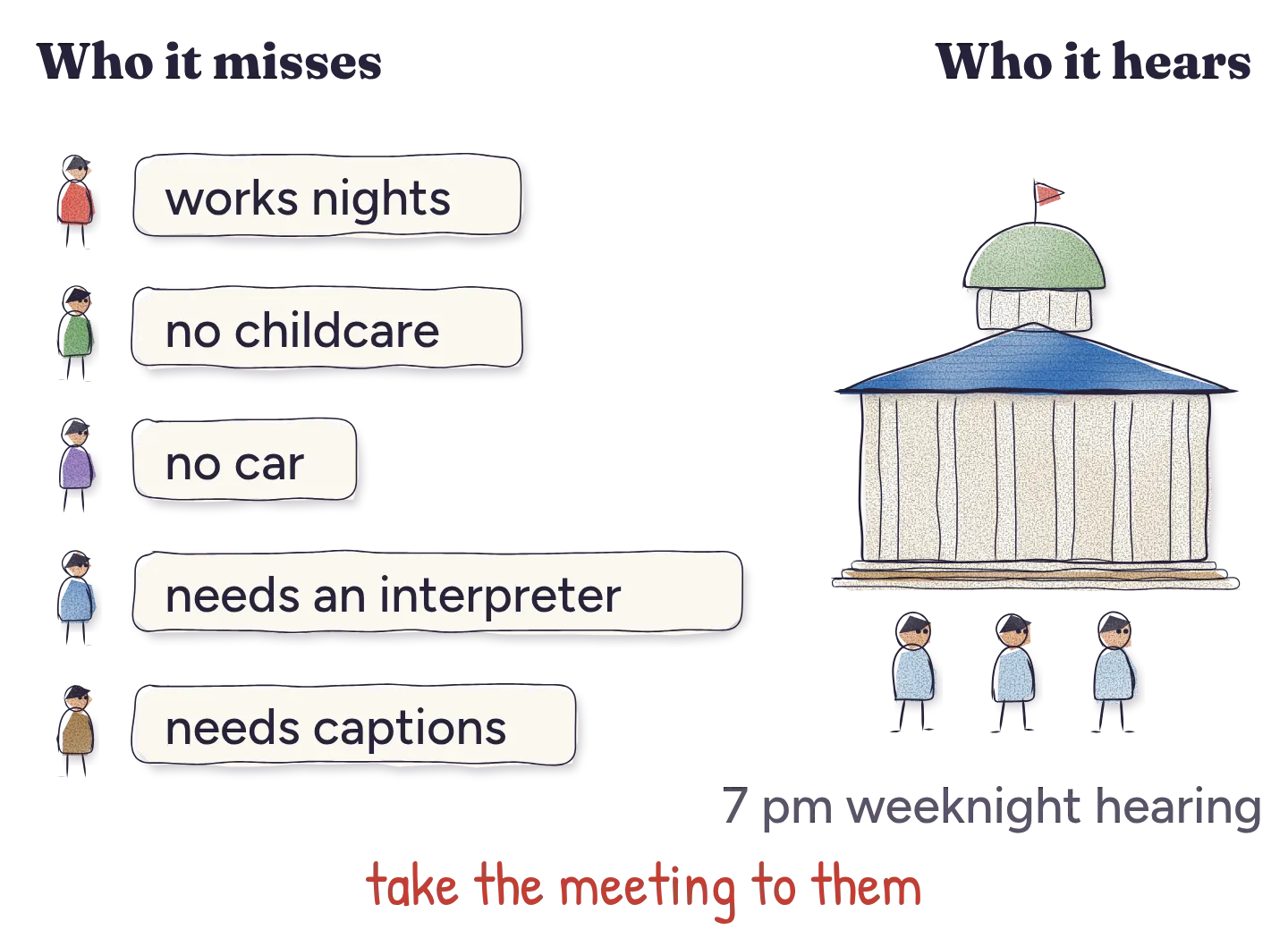
Traditional engagement, such as a weeknight hearing at city hall, a notice in the newspaper, or a 60-page PDF, reliably hears from people with time, transportation, English fluency, and confidence that government will listen. It reliably misses renters, shift workers, parents of young children, youth, people with disabilities, immigrants, and residents whose experience with government has taught them distrust.
Common barriers and how to lower them:
| Barrier | Response |
|---|---|
| Time and schedules | Varied times, weekends, online and asynchronous options, pop-ups where people already are |
| Language | Translated materials, interpreters, multilingual staff, plain language |
| Childcare, food, transportation | Provide childcare and meals; meet on transit lines or in neighborhoods |
| Distrust | Partner with trusted community-based organizations, show up consistently, report back on what changed |
| Disability | Accessible venues, interpreters, captioning, accessible documents and websites |
| Digital divide | Pair online tools with in-person and phone options |
| Fear (for example, of immigration enforcement) | Don't require identification; explain how information is used; work through trusted messengers |
When partnering with community organizations, pay them for their time and expertise. They're doing real work, and relying on unpaid labor from under-resourced groups repeats the inequity you're trying to address.
5 more sections follow in the full lesson.
Key terms
- Community-based organization (CBO): A local nonprofit or group rooted in and trusted by a community.
- Procedural equity: Fair, inclusive, transparent decision-making processes.
- Distributive equity: Fair distribution of benefits and burdens.
- Structural equity: Addressing historical and systemic causes of inequity.
- Equity analysis: A structured review of who a proposal benefits and burdens, done before the decision.
- Disaggregated data: Data broken down by group or place instead of reported as one overall average.
- Limited English proficiency (LEP): Limited ability to read, write, speak, or understand English.
- Environmental justice: Fair treatment and meaningful involvement of all people in environmental decisions, and avoiding disproportionate burdens.
- Cultural humility: An ongoing practice of self-reflection and learning that recognizes the limits of one's own perspective.
- Section 508: The federal requirement that agencies' information technology be accessible.
- WCAG: The Web Content Accessibility Guidelines, the standard for accessible digital content.
- Plain language: Writing that the intended audience can understand the first time they read it.
Create an account to see the rest of this lesson
Every lesson and full-length practice exam is open to you. An account keeps your scores and progress in one place so you can see where to study next.
Just looking? The list of lessons and the sample questions are open to everyone.
Ready for exam-style questions?
The checkpoints in this lesson were written for it alone, so they never give away an exam question. To see how the Communication domain is tested, take a full-length practice exam. It mixes all nine domains in exam proportions, and your results point you back to the lessons behind every question you miss.
Exams need an account, so your scores are saved. Create one to get started.