
Variances, rezonings, and nonconformities
Area and use variances, rezonings and spot zoning, contract zoning, quasi-judicial decisions, nonconforming uses, amortization, moratoria, and appeals and judicial review.
Lesson 20 of 40 · about 27 minutes · Outline areas: 5.1 Develop and interpret rules and regulations
Learning objectives
- Distinguish area and use variances and apply the standard tests for granting a variance.
- Explain the difference between legislative and quasi-judicial rezonings, including the Fasano doctrine.
- Recognize spot zoning and distinguish contract zoning from conditional zoning.
- Explain how nonconforming uses, structures, and lots are treated, including amortization and abandonment.
- Describe what makes a development moratorium legally defensible.
- Explain how zoning decisions are appealed and how courts review them.
Key concepts
Zoning can't anticipate every property. The ordinance therefore provides ways to adjust the rules for specific situations, and ways to handle development that was legal before the rules changed. The exam tests these tools heavily.
Variances
A variance is permission to depart from the ordinance's literal terms because applying them to a particular property would cause undue hardship. Variances are quasi-judicial decisions, usually made by the board of zoning adjustment (appeals) after notice and a hearing.
Two kinds:
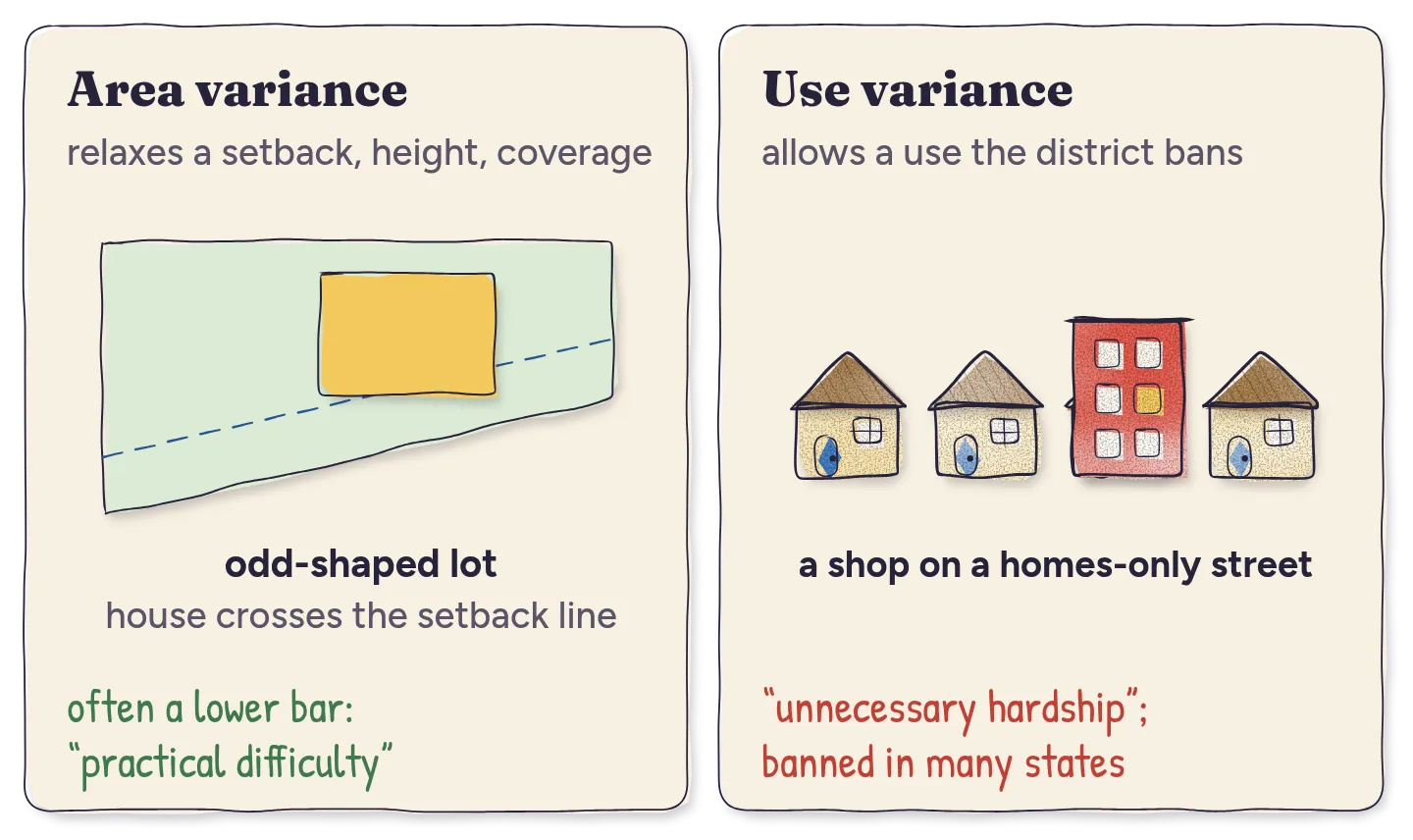
- An area (dimensional) variance relaxes a dimensional standard such as a setback, height, lot coverage, or parking requirement. Many states apply a lower standard for these, sometimes called "practical difficulty."
- A use variance allows a use the district doesn't permit. It requires the stricter "unnecessary hardship" standard, and many states and ordinances prohibit use variances entirely, because allowing new uses is a legislative decision better handled by rezoning.
Typical findings required (terms vary by state):
- The hardship arises from conditions unique to the property, such as an irregular shape, steep topography, or an unusually shallow lot, not from conditions common to the neighborhood.
- The hardship was not self-created by the owner (buying a lot knowing it's substandard is often treated as self-created, though states differ).
- Strict application would deny reasonable use of the property. Financial hardship alone, such as the ability to earn more money, isn't enough.
- The variance won't alter the essential character of the area or harm neighbors or the public.
- It's the minimum variance necessary to relieve the hardship.
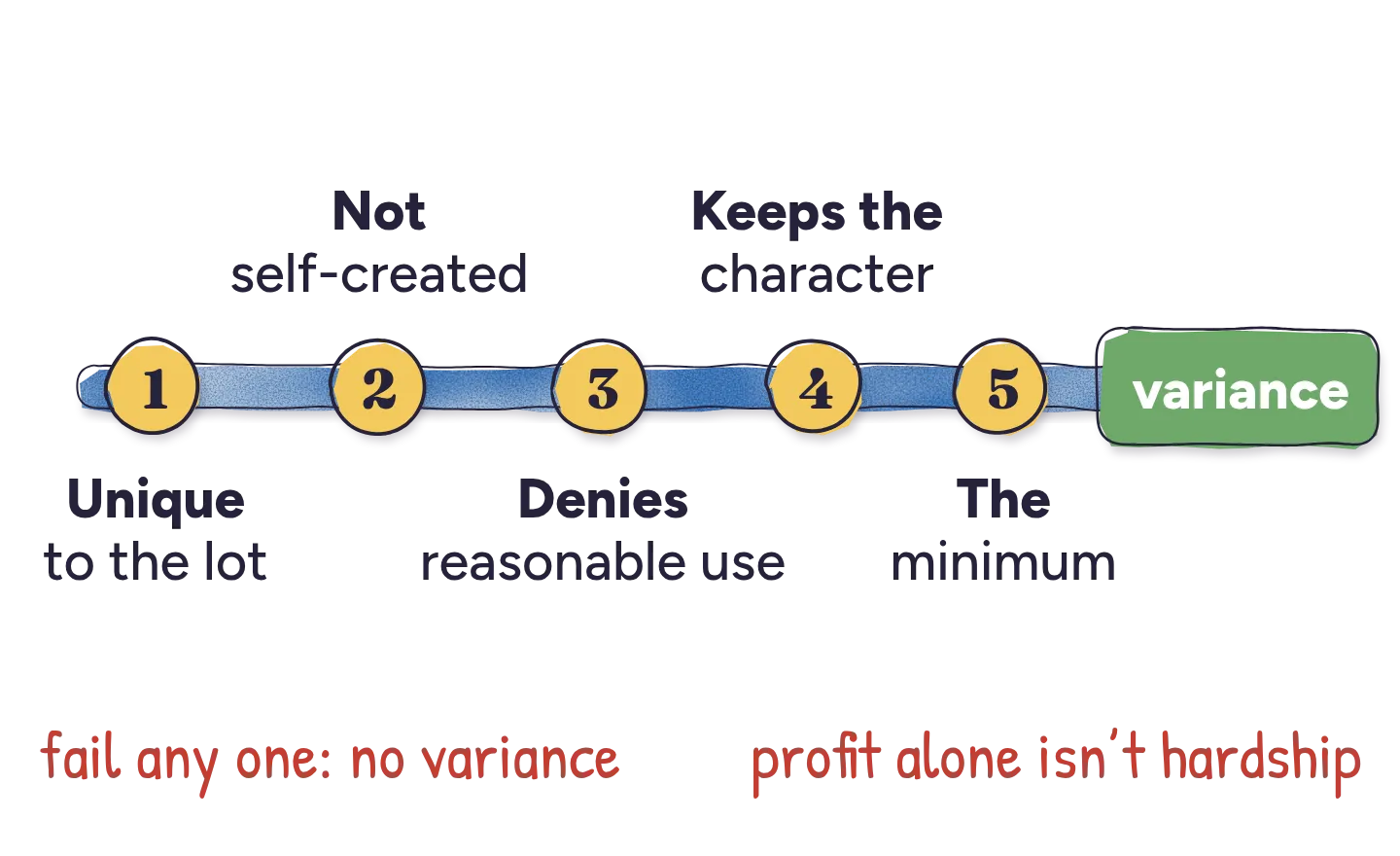
Applies the typical variance findings to two contrasting requests (an oddly shaped lot and a request for more profit) to show what counts as a hardship and what doesn't.
6 more sections follow in the full lesson.
Key terms
- Variance: Permission to depart from the ordinance's literal terms because of hardship unique to a property.
- Area (dimensional) variance: A variance from a dimensional standard.
- Use variance: A variance allowing a use not permitted in the district; prohibited in many states.
- Unnecessary hardship: The standard requiring that strict application would deny reasonable use because of the property's unique conditions.
- Self-created hardship: Hardship caused by the owner's own actions, which usually bars a variance.
- Quasi-judicial rezoning: A site-specific rezoning treated as applying policy, requiring findings and due process (Fasano).
- Spot zoning: Singling out a small parcel for inconsistent zoning mainly to benefit its owner.
- Contract zoning: A bilateral rezoning bargain, generally invalid.
- Conditional zoning: A rezoning with conditions attached, accepted in many states.
- Legal nonconforming use: A use lawfully established before current rules that no longer conforms.
- Amortization: Requiring a nonconforming use to end after a period meant to allow recovery of investment.
- Abandonment: Discontinuing a nonconforming use for a set period, ending the right to resume it.
- Moratorium: A temporary halt on specified development approvals.
- Exhaustion of administrative remedies: The rule that a challenger must use local appeals before going to court.
- Fairly debatable: The deferential standard courts apply to legislative zoning decisions.
- Substantial evidence: The standard for quasi-judicial decisions: enough relevant evidence in the record to support the decision.
Create an account to see the rest of this lesson
Every lesson and full-length practice exam is open to you. An account keeps your scores and progress in one place so you can see where to study next.
Just looking? The list of lessons and the sample questions are open to everyone.
Ready for exam-style questions?
The checkpoints in this lesson were written for it alone, so they never give away an exam question. To see how the Implementation domain is tested, take a full-length practice exam. It mixes all nine domains in exam proportions, and your results point you back to the lessons behind every question you miss.
Exams need an account, so your scores are saved. Create one to get started.