
Working through ethics scenarios
A repeatable method for ethics questions, with worked cases on political pressure, client advocacy, objective analysis, and social media, data, and AI tools.
Lesson 40 of 40 · about 23 minutes · Outline areas: 9.1 Overall responsibility to the public; 9.4 Upholding the rules of conduct
Read the full Code before exam day. The method and scenarios here apply our summaries of the AICP Code of Ethics and Professional Conduct. The Code itself, on APA's website, is the authority, and reading it once through makes the exam's wording familiar.
Learning objectives
- Use a repeatable five-step method to answer ethics questions.
- Handle political pressure and directives to alter analysis without violating the Code.
- Explain the special obligation to the public interest that private-sector planners carry.
- Respond correctly when a client wants an analysis that supports a predetermined conclusion.
- Work through multi-part ethics scenarios involving conflicts, disclosure, and colleagues' misconduct.
- Apply the same principles to social media, data, and new analytical tools such as AI.
Key concepts
Ethics questions make up about a tenth of the exam and reward a consistent method more than memorization. Most wrong answers are either too passive (ignore it, let someone else decide) or too aggressive (go to the press, quit on the spot, file a charge before raising the issue).
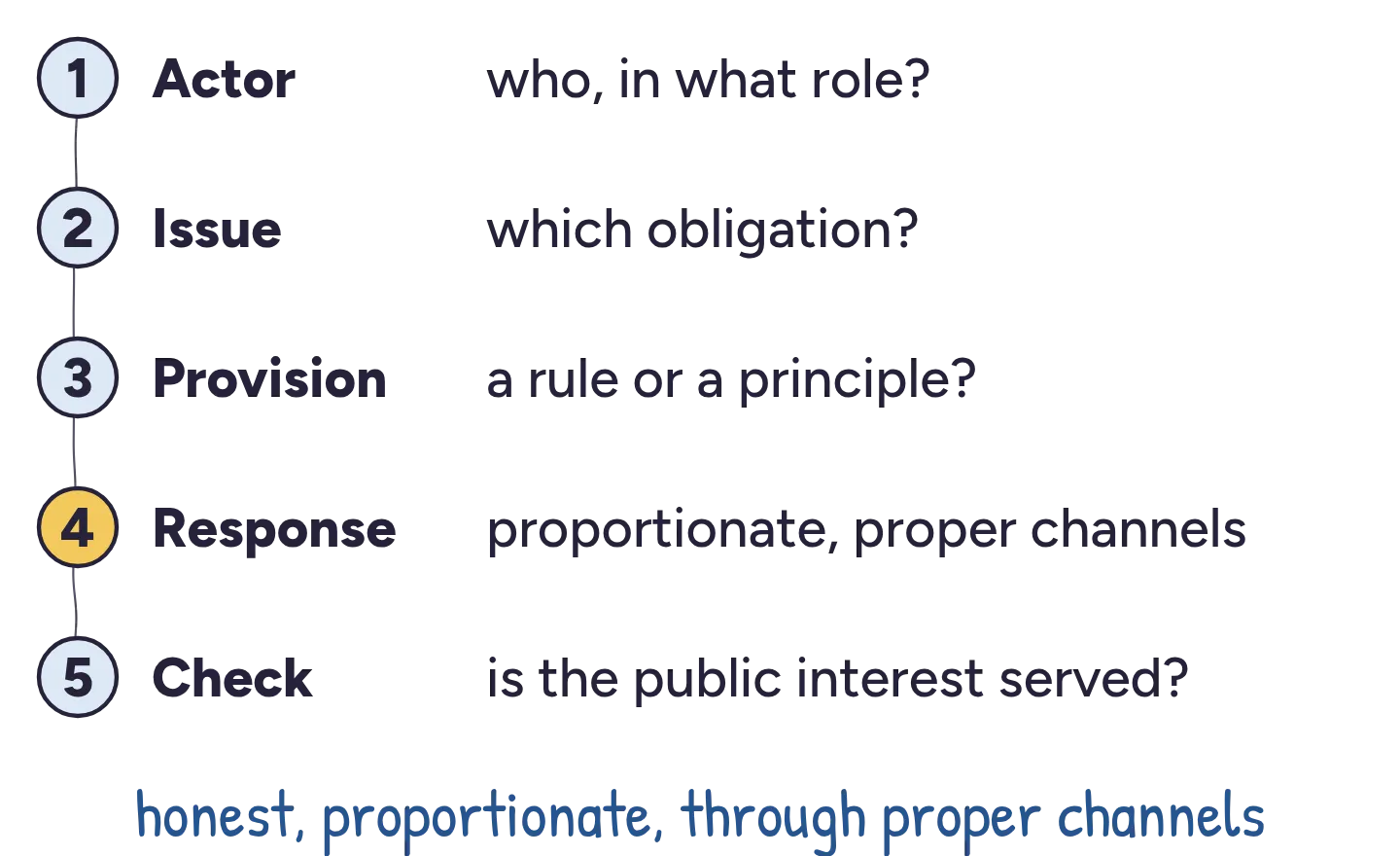
A five-step method
- Identify the actor and their role. Is the person an AICP member? Public employee, consultant, or commissioner? What's their relationship to the matter?
- Name the issue. A conflict of interest? A gift? Confidential information? Misrepresentation? Competence? Political pressure? Pinpoint the specific obligation.
- Find the governing provision. Is it a Rule of Conduct (enforceable) or an aspirational principle? If the question asks whether conduct "violates the Code," only a rule can be violated.
- Choose the most appropriate response. It's usually the one that is honest, proportionate, and uses proper channels: disclose, withdraw, decline, correct the record, or raise the concern with the right person.
- Check it against the public interest. Does the answer protect the integrity of the planning process and the public's right to accurate information?
Some questions give answer choices such as "definitely violates," "possibly violates," "does not violate," or "insufficient information." Use "insufficient information" only when a fact that would change the answer is genuinely missing, not as a way to avoid a judgment call.
6 more sections follow in the full lesson.
Key terms
- Independent professional judgment: A planner's own honest, competent assessment.
- Special obligation to the public interest: The duty, stronger than client loyalty, that constrains private-sector work.
- Predetermined conclusion: An outcome decided before analysis, which a planner may not manufacture support for.
- Proper channels: The appropriate internal and professional routes for raising concerns.
- Ex parte communication: Contact with a decision-maker about a pending quasi-judicial matter outside the hearing.
- Escalation: Raising a concern to a higher level when it isn't resolved.
- Generative AI: Software that produces text, images, or analysis from prompts; the planner remains responsible for its output.
Create an account to see the rest of this lesson
Every lesson and full-length practice exam is open to you. An account keeps your scores and progress in one place so you can see where to study next.
Just looking? The list of lessons and the sample questions are open to everyone.
Ready for exam-style questions?
The checkpoints in this lesson were written for it alone, so they never give away an exam question. To see how the Ethics domain is tested, take a full-length practice exam. It mixes all nine domains in exam proportions, and your results point you back to the lessons behind every question you miss.
Exams need an account, so your scores are saved. Create one to get started.