
A history of American planning
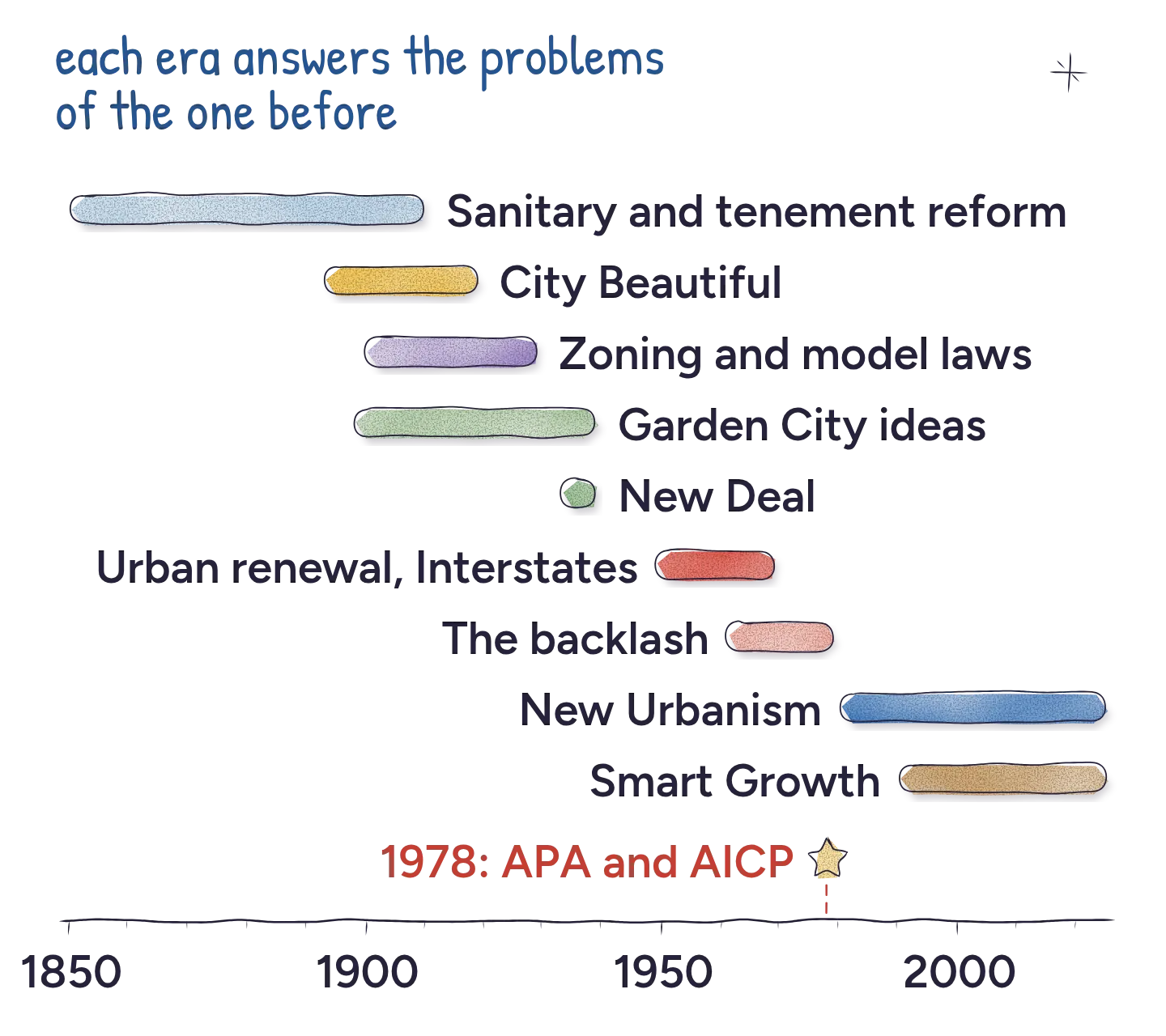
From colonial town plans and sanitary reform through the City Beautiful, the Garden City, the New Deal, urban renewal, the quiet revolution, New Urbanism, and Smart Growth.
Lesson 5 of 40 · about 34 minutes · Outline areas: 2.1 History of planning and planning movements
Learning objectives
- Recognize the colonial and early American town plans that shaped U.S. cities, from the Laws of the Indies to the national land survey grid.
- Place the major American planning movements in chronological order and explain what problem each was responding to.
- Connect key figures (Olmsted, Burnham, Howard, Perry, Stein and Wright, Mumford, Moses, Jacobs) to their ideas and projects.
- Explain how federal programs from the New Deal through urban renewal and the Interstate era reshaped cities.
- Describe the reactions that followed: preservation, advocacy planning, environmental planning, New Urbanism, and Smart Growth.
- Trace how the planning profession organized itself, up to the founding of APA and AICP.
Key concepts
The exam doesn't expect you to memorize every date. It expects you to know what came first, what each movement was reacting against, and who is associated with what. Think of planning history as a chain of problems and responses.
Before the movements: early town plans (1500s to 1800s)
American cities carry the imprint of plans far older than the planning profession:
- The Spanish Laws of the Indies (1573) set rules for colonial towns: a central plaza surrounded by the church and government buildings, with streets laid out in a grid. Many towns in the Southwest, such as Santa Fe and San Antonio, still show the pattern.
- William Penn's plan for Philadelphia (1682), laid out with surveyor Thomas Holme, set a grid between two rivers with five public squares.
- James Oglethorpe's plan for Savannah (1733) organized the town into wards, each built around a small public square, a pattern that could repeat as the town grew.
- Pierre L'Enfant's plan for Washington, D.C. (1791) laid broad diagonal avenues over a street grid, linking major sites with sightlines in the Baroque manner.
- The Land Ordinance of 1785 set up the rectangular survey of the public domain west of the original states: townships 6 miles square, divided into 36 sections of one square mile (640 acres) each. It explains the grid of roads and property lines across much of the Midwest and West.
- New York's Commissioners' Plan of 1811 laid a uniform grid over most of Manhattan, favoring easy land sale over topography.
In Europe, Baron Haussmann's rebuilding of Paris in the 1850s and 1860s cut wide boulevards through the old city, with new sewers, parks, and unified building fronts. It later inspired the City Beautiful movement.
9 more sections follow in the full lesson.
Key terms
- Laws of the Indies: Spanish colonial rules (1573) for towns organized around a central plaza and a grid.
- Land Ordinance of 1785: The federal act creating the rectangular survey of townships (6 miles square) and 640-acre sections.
- Settlement house: A neighborhood center where reformers lived and worked among poor residents, such as Jane Addams's Hull House.
- Radiant City: Le Corbusier's modernist vision of widely spaced towers in parkland with separated uses.
- Broadacre City: Frank Lloyd Wright's dispersed, automobile-based vision of about an acre per family.
- Quiet revolution: The 1970s shift of some land use authority back to the states.
- Transect: A rural-to-urban gradient of settings used by New Urbanists to organize development and codes.
- Sanitary reform: Nineteenth-century public health improvements such as water and sewer systems.
- City Beautiful movement: A late-1800s to early-1900s movement for monumental civic design, launched by the 1893 Chicago exposition.
- Plan of Chicago (1909): Burnham and Bennett's regional plan, the landmark of the City Beautiful era.
- Garden City: Howard's concept of a size-limited, self-contained town ringed by a permanent greenbelt.
- Neighborhood unit: Perry's residential unit centered on an elementary school, bounded by arterials.
- Radburn: Stein and Wright's 1929 New Jersey town of superblocks and cul-de-sacs, with separated pedestrian paths.
- Greenbelt towns: Three New Deal communities built by the Resettlement Administration.
- Urban renewal: The federal program, launched in 1949, that funded clearing and redeveloping "blighted" areas.
- Section 701: The 1954 Housing Act program that funded local and regional planning.
- New Urbanism: A design movement for walkable, mixed-use, traditional neighborhoods.
- Smart Growth: Regional growth policy favoring compact development, infill, and transportation choice.
- Three E's: Environment, economy, and equity, the pillars of sustainability.
Create an account to see the rest of this lesson
Every lesson and full-length practice exam is open to you. An account keeps your scores and progress in one place so you can see where to study next.
Just looking? The list of lessons and the sample questions are open to everyone.
Ready for exam-style questions?
The checkpoints in this lesson were written for it alone, so they never give away an exam question. To see how the Fundamentals domain is tested, take a full-length practice exam. It mixes all nine domains in exam proportions, and your results point you back to the lessons behind every question you miss.
Exams need an account, so your scores are saved. Create one to get started.