
Growth management and innovative land use tools
Form-based codes, PUDs, performance zoning, cluster subdivisions, TDR and PDR, inclusionary zoning, urban growth boundaries, and concurrency.
Lesson 22 of 40 · about 26 minutes · Outline areas: 5.1 Develop and interpret rules and regulations; 4.9 Applying innovations and best practices
Learning objectives
- Explain how form-based codes, PUDs, and performance zoning differ from conventional zoning.
- Describe incentive and inclusionary zoning and what makes an inclusionary program work.
- Explain how transfer and purchase of development rights protect land, and what a TDR program needs to function.
- Describe growth management tools: urban growth boundaries, concurrency and adequate public facilities, and phased or capped growth.
- Summarize Ramapo and Petaluma and why they matter.
Key concepts
Conventional Euclidean zoning separates uses and regulates by lists and numbers. The tools in this lesson emerged to fix its weaknesses: rigidity, car-dependent patterns, sprawl, and exclusion.
Form-based codes
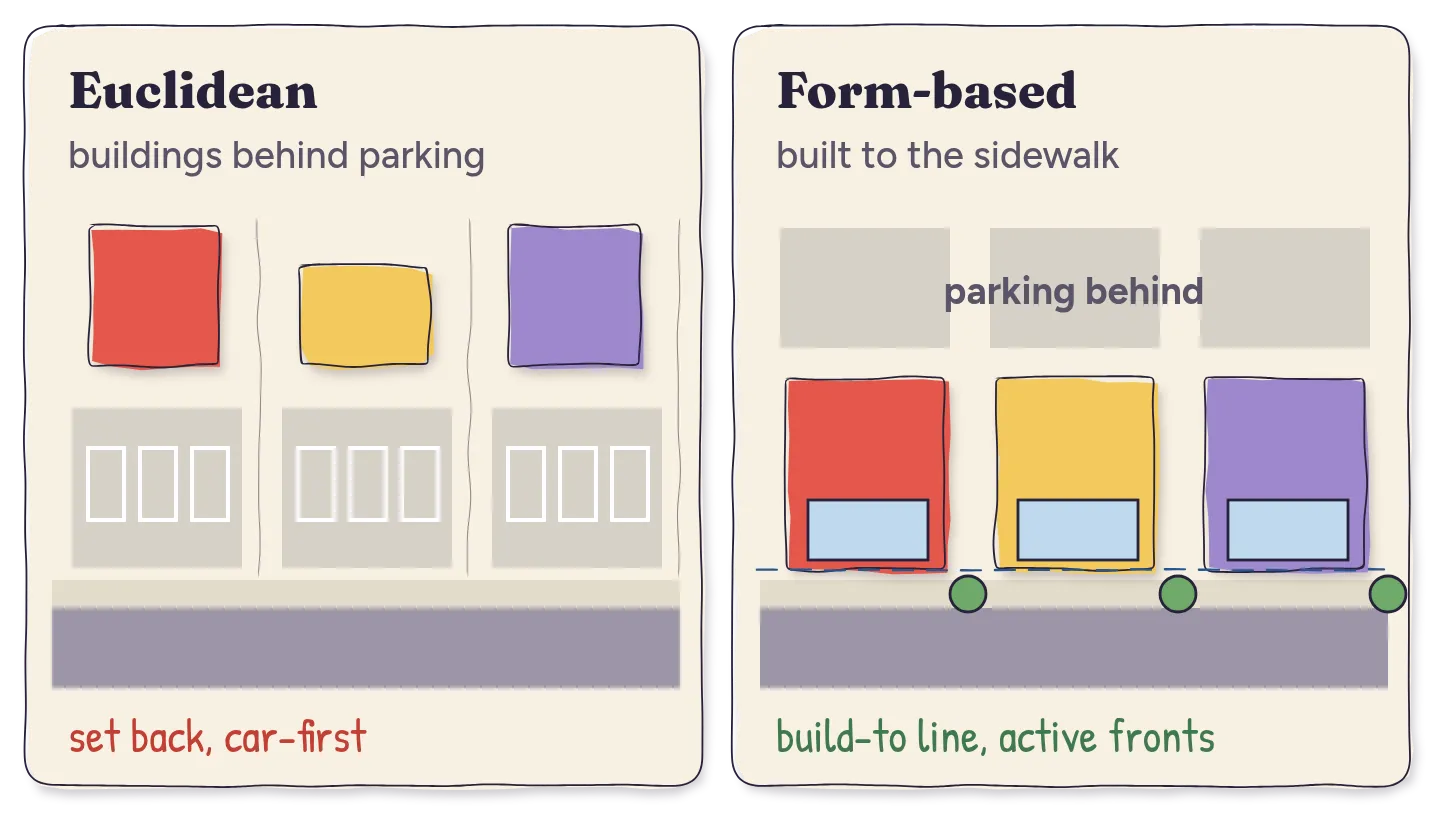
A form-based code regulates primarily physical form and the public realm: how buildings relate to the street, their height and placement, frontage types, and the design of streets and public spaces. Use is secondary, often regulated broadly. Typical components:
- a regulating plan (a map showing where different form standards apply);
- building form standards (build-to lines, height in stories, frontage requirements, ground-floor transparency);
- public space (street) standards (sidewalk widths, street trees, lanes); and
- often frontage type and architectural standards.
Many form-based codes are organized by the transect, a gradient of contexts from rural to urban core, with standards calibrated to each zone along it. The widely used SmartCode model defines transect zones from natural and rural (T1, T2) through suburban and general urban to urban center and core (T6), plus special districts.
Form-based codes are especially useful for corridors and downtowns where the goal is a predictable, walkable street frontage over time. Many cities adopt a hybrid code, adding form-based standards to a conventional ordinance for certain districts, rather than replacing the whole code. Many also combine zoning, subdivision, and other development rules into a single unified development code (UDC) so applicants find everything in one place.
8 more sections follow in the full lesson.
Key terms
- Form-based code: A code regulating building form and the public realm, with use secondary.
- Regulating plan: A form-based code's map showing where form standards apply.
- Transect: A rural-to-urban gradient used to organize form-based standards.
- Planned unit development (PUD): A master-planned project allowed flexibility in exchange for public benefits.
- Performance zoning: Regulation by measurable impacts rather than lists of uses.
- Cluster (conservation) subdivision: Homes concentrated on smaller lots to preserve open space.
- Density bonus: Extra development capacity granted for a public benefit.
- Inclusionary zoning: A requirement or incentive for a share of new units to be affordable.
- Transfer of development rights (TDR): The sale of development rights from sending areas to receiving areas.
- Purchase of development rights (PDR): Public purchase of development rights, usually via conservation easement.
- Urban growth boundary (UGB): A line separating land planned for urban development from rural land.
- Concurrency: The requirement that facilities be available at adopted levels of service as development occurs.
- Adequate public facilities ordinance (APFO): A rule conditioning approval on adequate infrastructure.
- Hybrid code: A conventional zoning ordinance with form-based standards added for some districts.
- Unified development code: A single ordinance combining zoning, subdivision, and other development regulations.
Create an account to see the rest of this lesson
Every lesson and full-length practice exam is open to you. An account keeps your scores and progress in one place so you can see where to study next.
Just looking? The list of lessons and the sample questions are open to everyone.
Ready for exam-style questions?
The checkpoints in this lesson were written for it alone, so they never give away an exam question. To see how the Implementation domain is tested, take a full-length practice exam. It mixes all nine domains in exam proportions, and your results point you back to the lessons behind every question you miss.
Exams need an account, so your scores are saved. Create one to get started.