
Staff reports, hearings, and the media
Writing staff reports, presentations and honest visuals, the roles of staff and officials, meeting procedure, hearings and ex parte contacts, evidence-based arguments, and working with the press.
Lesson 14 of 40 · about 26 minutes · Outline areas: 3.4 Leadership and influencing decision-making; 3.8 Role of organizational structures and functions; 3.11 Evidence-based argument formulation; 3.12 Sensitive or complex political situation management
Learning objectives
- Distinguish the roles of professional staff, appointed boards, and elected officials in planning decisions.
- Write a staff report that leads with the recommendation and analyzes the request against adopted criteria.
- Build an evidence-based argument and communicate technical findings and risk to non-experts, in writing, in presentations, and with honest visuals.
- Explain hearing requirements for quasi-judicial decisions, including notice, the record, and ex parte contacts.
- Describe how a public body conducts business: agendas, quorums, motions, and consent agendas.
- Handle media inquiries, misinformation, and political pressure professionally.
Key concepts
Who does what
- Professional staff gather facts, analyze options, apply adopted plans and codes, and make recommendations.
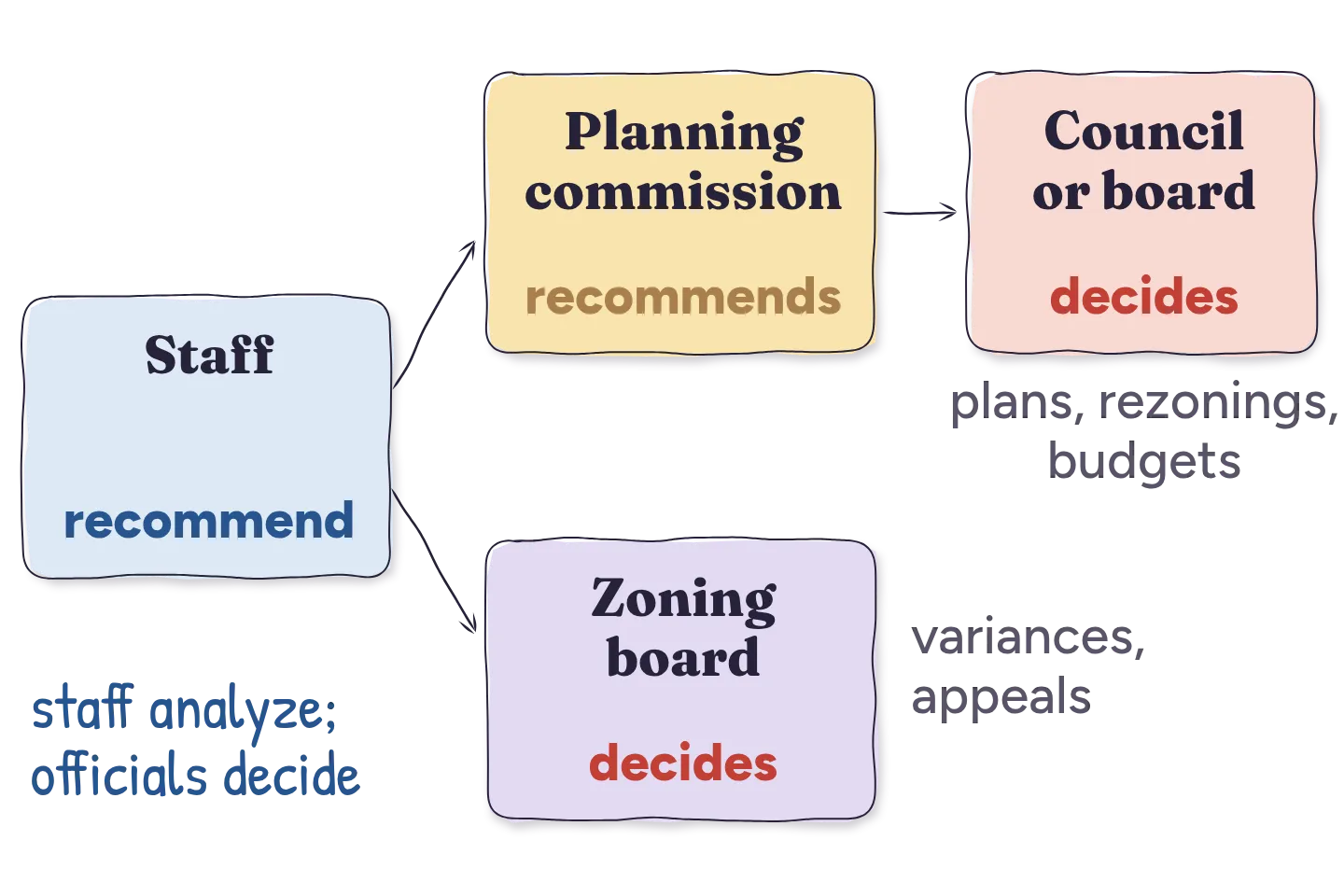
- Appointed bodies advise or decide within the authority the law gives them. A planning commission typically holds hearings on plans and rezonings and recommends to the governing body; a board of zoning adjustment (or appeals) typically decides variances and appeals of administrative decisions.
- Elected officials (a city council or county board) make the legislative decisions: adopting plans, zoning ordinances, rezonings, and budgets.
The short version: staff analyze and recommend; elected officials decide. Staff owe decision-makers honest, complete analysis, and once a lawful decision is made, staff carry it out professionally even if they recommended otherwise.
9 more sections follow in the full lesson.
Key terms
- Staff report: The written analysis and recommendation staff prepare for a decision-making body.
- Findings of fact: Written conclusions tying evidence to each approval criterion.
- Legislative decision: A policy-making decision of general application, such as adopting a plan or code.
- Quasi-judicial decision: A decision applying adopted rules to a specific property or party.
- Public hearing: A formal, noticed proceeding that creates the record for a decision.
- Ex parte communication: Contact with a decision-maker about a pending quasi-judicial matter outside the hearing.
- Board of zoning adjustment (appeals): The body that typically decides variances and administrative appeals.
- Evidence-based argument: A recommendation grounded in data, analysis, and documented input.
- Plain language: Writing the audience can understand the first time.
- Quorum: The minimum number of members who must be present for a body to act.
- Consent agenda: Routine items approved together in a single vote.
- Robert's Rules of Order: The most widely used guide to parliamentary procedure.
- Photo simulation: A photo of an existing place altered to show a proposed change at true scale.
Create an account to see the rest of this lesson
Every lesson and full-length practice exam is open to you. An account keeps your scores and progress in one place so you can see where to study next.
Just looking? The list of lessons and the sample questions are open to everyone.
Ready for exam-style questions?
The checkpoints in this lesson were written for it alone, so they never give away an exam question. To see how the Communication domain is tested, take a full-length practice exam. It mixes all nine domains in exam proportions, and your results point you back to the lessons behind every question you miss.
Exams need an account, so your scores are saved. Create one to get started.